L-TAURINE – is an important but non-essential amino acid if longevity is your goal. Research has found that the longest living Japanese residents on the island of Okinawa have the highest intakes of L-Taurine. It has its greatest impact on strengthening the cardiovascular system (lowers blood pressure), improving insulin sensitivity (prevents fatty liver), and optimizing the immune system and the nervous system (helps treat seizures and reverses tinnitus).
L-Taurine also helps fight obesity – mostly through its ability to improve insulin resistance, metabolic syndrome, and diabetes. Additionally, it reduces the complications of diabetes (heart disease, kidney damage, diabetic retinopathy and neuropathy). One of the best ways to improve exercise performance is to take an L-Taurine supplement beforehand because it helps muscles work harder and longer without injury.
L-Taurine is also crucial for eye health because of its ability to prevent retinal damage and macular degeneration, the leading cause of blindness. And it has an especially important role to play in prevention of diabetic retinopathy.
And tinnitus (ringing in the ears) is another nuisance health problem that could be helped by supplemental L-Taurine. (Recommended dosage: 500 – 1000 mg daily)
Why Plant-based Diet for Longevity?
Together, distilled water, plant-based diet with supplements and exercise plan will make you invincible in the quest to maximum longevity.
The low-methionine content of vegan diets may make methionine restriction feasible as a life extension strategy.
Does low meat consumption increase life expectancy in humans?
Beyond meatless, the health effects of vegan diets: findings from the Adventist cohorts.
Vegan proteins may reduce risk of cancer, obesity, and cardiovascular disease by promoting increased glucagon activity.
The origins of western obesity: a role for animal protein?
The health advantage of a vegan diet: exploring the gut microbiota connection.
Rice
Lotus Foods, Heirloom Forbidden Rice, 15 oz (426 g)
Lotus Foods, Organic Forbidden Rice, 15 oz (426 g)
Lotus Foods, Heirloom Bhutan Red Rice, 15 oz (426 g)
The low-methionine content of vegan diets may make methionine restriction feasible as a life extension strategy.
Does low meat consumption increase life expectancy in humans?
Beyond meatless, the health effects of vegan diets: findings from the Adventist cohorts.
Vegan proteins may reduce risk of cancer, obesity, and cardiovascular disease by promoting increased glucagon activity.
The origins of western obesity: a role for animal protein?
The health advantage of a vegan diet: exploring the gut microbiota connection.
Rice
Lotus Foods, Heirloom Forbidden Rice, 15 oz (426 g)
Lotus Foods, Organic Forbidden Rice, 15 oz (426 g)
Lotus Foods, Heirloom Bhutan Red Rice, 15 oz (426 g)

Distilled Waters
Two ideal water sources for longevity:
1. Distilled water is water that has been heated to the boiling point so that impurities
are separated from the water, which itself becomes vapor or steam. Steam is then
condensed back into pure liquid form. The impurities remain as residue and are
1. Distilled water is water that has been heated to the boiling point so that impurities
are separated from the water, which itself becomes vapor or steam. Steam is then
condensed back into pure liquid form. The impurities remain as residue and are
removed. A distillation system removes waterborne biological contaminants such
as bacteria, viruses, organic and inorganic chemicals, heavy metals, volatile gases,
cysts and other contaminants. Distilled water contains virtually no solids, mineral
or trace elements. It is clean, natural and healthy. Steam distilled water is the
standard by which all other waters are measured.
Water distiller (Meditech, Europe)
2. Plant water is naturally purified by plants, like coconut water, cucumber water and
watermelon.
as bacteria, viruses, organic and inorganic chemicals, heavy metals, volatile gases,
cysts and other contaminants. Distilled water contains virtually no solids, mineral
or trace elements. It is clean, natural and healthy. Steam distilled water is the
standard by which all other waters are measured.
Water distiller (Meditech, Europe)
2. Plant water is naturally purified by plants, like coconut water, cucumber water and
watermelon.
Acupoint Stomach 36 and longevity

In recent records, it is well known that Doctor Shimetaro Hara used to burn Moxa on his St-36 every day and he lived to be over 100 years of age
Scientific studies cited by Dr. Shui Yin Lo in his book, The Biophysics for Acupuncture and Health; found that normal subjects who received acupuncture on acupoint Stomach 36, increased telomerase levels.
Clinical research now posits that stimulating St-36 increases Maximum Oxygen Uptake. It is known that increased Maximum Oxygen Uptake prevents and improves recovery time from diseases such as hypertension and diabetes. Maximum Oxygen Uptake also decreases the cancer rate. Thus, we may assume that the modern idea of maintaining health by increasing Maximum Oxygen Uptake is based on the same mechanism as our traditional wisdom for attaining longevity by stimulating St 36.
St-36 is located on the network called the Stomach Meridian. Stimulation of St-36 not only enlivens the point but also the entire meridian and stomach organ. According to this classic medical theory, the organ and meridian of the stomach are a part of the foundation of our life energy. Thus, stimulation on St-36 not only affects the leg where St-36 is located, but also affects the health of the whole body.
Preventing illness before it rears its ugly head is the core idea in acupuncture and moxibustion theory. Ancient Chinese physicians observed the early stages of decline in health, which precedes illness proper, also manifests subtle symptoms. They believed it wise to treat illnesses at this stage. This stage is called ‘Mi Bing’ which means ‘before illness.’ 'Mi Bing' is closely related to the idea of longevity and Moxibustion on the acupuncture point St-36
One of the most famous preventative moxa therapies is to do indirect moxibustion on St-36 (Stomach 36 / Zu San Li) a point one hand's width below the patella (knee cap). Zu San Li means 'Foot Three Miles' and increases endurance, digestive power, and stimulates the immune system.
.
Plant water and Distilled Shungite water
Two deal water sources for longevity
1. Plant water
Water that is naturally purified by plants, like coconut water, cucumber water and
watermelon.
2. Distilled Shungite water
Pour distilled water in the glass jar for 3 days with noble shungite.
Shungite (ebook in Russian language)
1. Plant water
Water that is naturally purified by plants, like coconut water, cucumber water and
watermelon.
2. Distilled Shungite water
Pour distilled water in the glass jar for 3 days with noble shungite.
Shungite (ebook in Russian language)
Supplements
Longevity Lifestyle Plan is not ideal for without certain supplements. Here we present the best longevity supplements which should be used together with the diet.
If you are shopping at iHerb for the first time, use my coupon code REF-952 for $5.00 off your first order.
Acetyl L-Carnitine (ALCAR)
Doctor's Best, Best Acetyl-L-Carnitine , 500 mg, 120 Capsules
Astragalus root:
telomere elongation
Gaia Herbs, Astragalus Root, Alcohol Free, 1 fl oz (30 ml)
Nature's Answer, Astragalus, Alcohol-Free, 2,000 mg, 1 fl oz (30 ml)
B12, methylcobalamin (1500 mcg/day):
telomere protection, anti-homocysteine
Doctor's Best, Best Fully Active B12, 1500 mcg, 60 Veggie Caps
Carnosine (1000 mg/day)
Doctor's Best, Best Carnosine, 500 mg, 90 Veggie Caps
Flaxseed oil:
alpha-linolenic acid from flaxseed may be better Omega-3 for longevity than DHA & EPA.
Solgar, Earth Source, Organic, Flaxseed Oil, 16 fl oz (473 ml)
Gynostemma
Vegan D3 from lichen (5000 IU/ day):
telomere protection
Doctor's Best, Best Vegan D3, 2500 IU, 60 Veggie Caps
Vitamin K2, (90 mcg/day):
anti-atherosclerosis. anti-osteoporosis, anti-cancer
Doctor's Best, Natural Vitamin K2, 45 mcg, 60 Veggie Caps
Taurine (1000 mg/day):
anti-tinnitus, anti-cataract
Doctor's Best, Best Taurine, 500 mg, 120 Veggie Caps
TMG, Trimethylglycine (2000 mg/day):
telomere protection, anti-homocysteine
Life Extension, TMG, 1000 mg, 60 Veggie Liquid Caps
Milk thistle (Silymarin):
telomere elongation, anti-cancer, anti-inflammation, detox
Eclectic Institute, Milk Thistle, 600 mg, 240 Veggie Caps
Turmeric (Curcumin):
anti-cancer, anti-inflammation, anti-Alzheimer´s
Organic India, Turmeric Formula, Healthy Inflammation Response, 90 Veggie Caps
Nutritional yeast / Brewer´s yeast:
telomere protection, anti-homocysteine
Now Foods, Nutritional Yeast Flakes, 10 oz (284 g)
Nicotinamide Riboside:
cellular energy production, cellular aging shield
Doctor's Best, Best Energy Featuring Niagen, 75 mg, 60 Veggie Caps
Life Extension, NAD+ Cell Regenerator Nicotinamide Riboside, 100 mg, 30 Veggie Caps
Melatonin:
Life Extension, Melatonin, 1 mg, 60 Capsules
Perga - Bee bread (fermented bee pollen)
Perga - Bee bread (Aspermuehle)
Perga - Bee bread (Kirkkonummen mehilaistuote)
Perga - Bee bread (Heinaholma)
If you are shopping at iHerb for the first time, use my coupon code REF-952 for $5.00 off your first order.
Acetyl L-Carnitine (ALCAR)
Doctor's Best, Best Acetyl-L-Carnitine , 500 mg, 120 Capsules
Astragalus root:
telomere elongation
Gaia Herbs, Astragalus Root, Alcohol Free, 1 fl oz (30 ml)
Nature's Answer, Astragalus, Alcohol-Free, 2,000 mg, 1 fl oz (30 ml)
B12, methylcobalamin (1500 mcg/day):
telomere protection, anti-homocysteine
Doctor's Best, Best Fully Active B12, 1500 mcg, 60 Veggie Caps
Carnosine (1000 mg/day)
Doctor's Best, Best Carnosine, 500 mg, 90 Veggie Caps
Flaxseed oil:
alpha-linolenic acid from flaxseed may be better Omega-3 for longevity than DHA & EPA.
Solgar, Earth Source, Organic, Flaxseed Oil, 16 fl oz (473 ml)
Gynostemma
Vegan D3 from lichen (5000 IU/ day):
telomere protection
Doctor's Best, Best Vegan D3, 2500 IU, 60 Veggie Caps
Vitamin K2, (90 mcg/day):
anti-atherosclerosis. anti-osteoporosis, anti-cancer
Doctor's Best, Natural Vitamin K2, 45 mcg, 60 Veggie Caps
Taurine (1000 mg/day):
anti-tinnitus, anti-cataract
Doctor's Best, Best Taurine, 500 mg, 120 Veggie Caps
TMG, Trimethylglycine (2000 mg/day):
telomere protection, anti-homocysteine
Life Extension, TMG, 1000 mg, 60 Veggie Liquid Caps
Milk thistle (Silymarin):
telomere elongation, anti-cancer, anti-inflammation, detox
Eclectic Institute, Milk Thistle, 600 mg, 240 Veggie Caps
Turmeric (Curcumin):
anti-cancer, anti-inflammation, anti-Alzheimer´s
Organic India, Turmeric Formula, Healthy Inflammation Response, 90 Veggie Caps
Nutritional yeast / Brewer´s yeast:
telomere protection, anti-homocysteine
Now Foods, Nutritional Yeast Flakes, 10 oz (284 g)
Nicotinamide Riboside:
cellular energy production, cellular aging shield
Doctor's Best, Best Energy Featuring Niagen, 75 mg, 60 Veggie Caps
Life Extension, NAD+ Cell Regenerator Nicotinamide Riboside, 100 mg, 30 Veggie Caps
Melatonin:
Life Extension, Melatonin, 1 mg, 60 Capsules
Perga - Bee bread (fermented bee pollen)
Perga - Bee bread (Aspermuehle)
Perga - Bee bread (Kirkkonummen mehilaistuote)
Perga - Bee bread (Heinaholma)
Carnosine
The dipeptide carnosine (ß−alanyl-L-histidine) both inhibits glycation and has antioxidant metal chelating activity. Skeletal muscle concentrations of carnosine correlate with lifespan in mammals.
Brain Research Reviews 23:134-143 (1997)
Brain Research Reviews 23:134-143 (1997)
Mangosteen
1. Anti-fatigue agent
2. Anti-tumor and cancer preventative (multiple means of cancer prevention are cited)
3. Anti-aging elixir
4. Anti-oxidant agent
5. Hypotensive (lowers blood pressure)
6. Hypoglycemic (lowers bood sugar levels having an anti diabetic effect)
7. Immunostimulant (multiple catagories cited)
8. Antilipidemic – lowers blood fat levels
9. Anti-obesity – promotes weight loss
10. Antherosclerotic – prevents hardening of arteries
11. Cardioprotective
12. Antiviral
13. Antibiotic – modulates and prevents bacterial infections)
14. Anti-depressent
15. Anxyolytic – anti-anxiety effect
16. Anti-Alzheimerian – helps prevent dementia
17. Anti-arthritic
18. Antiperidontic – prevents gum disease
19. Antistenoporosis – helps prevent loss of bone mass
20. Antiallergenic – helps prevent allergic reactions
21. Antiseborric – prevents dandruff
22. Anticalculictic – helps prevent kidney stones
23. Antipyrectic – lowers fever
24. Anti-Parkinsons
25. Antidiahrreal
26. Antineuralgic – reduces nerve pain
27. Antivertigo – reduces dizziness
28. Antiglaucomic
29. Anticataract
2. Anti-tumor and cancer preventative (multiple means of cancer prevention are cited)
3. Anti-aging elixir
4. Anti-oxidant agent
5. Hypotensive (lowers blood pressure)
6. Hypoglycemic (lowers bood sugar levels having an anti diabetic effect)
7. Immunostimulant (multiple catagories cited)
8. Antilipidemic – lowers blood fat levels
9. Anti-obesity – promotes weight loss
10. Antherosclerotic – prevents hardening of arteries
11. Cardioprotective
12. Antiviral
13. Antibiotic – modulates and prevents bacterial infections)
14. Anti-depressent
15. Anxyolytic – anti-anxiety effect
16. Anti-Alzheimerian – helps prevent dementia
17. Anti-arthritic
18. Antiperidontic – prevents gum disease
19. Antistenoporosis – helps prevent loss of bone mass
20. Antiallergenic – helps prevent allergic reactions
21. Antiseborric – prevents dandruff
22. Anticalculictic – helps prevent kidney stones
23. Antipyrectic – lowers fever
24. Anti-Parkinsons
25. Antidiahrreal
26. Antineuralgic – reduces nerve pain
27. Antivertigo – reduces dizziness
28. Antiglaucomic
29. Anticataract
Gamma tocotrienol
Gamma tocotrienol (123) seems to be a telomerase activator according to Terraternal, so that Annatto, a plant with a pod that opens to reveal a kiss heavy with fruit rich in gamma tocotrienol, is an interesting new telomerase activator.
Tankyrase
(35) Tankyrase (Tankyrase 1,
telomeric PARP)
[GeneCards/Tankyrase,
Links,
Images,
Papers,
Patents,
Books,
WikiGenes/Tankyrase,
JL Mergny, JF Rois, et al., 2002;
Links/supplements promoting Tankyrase;
Images/Tankyrase molecule;
Links/Tankyrase 1,
Images,
Papers,
Patents,
Books;
Links/the Tankyrase 1 promoter,
Images,
Papers,
Patents,
Books;
Links/supplements promoting Tankyrase 1;
sources;
toxicity;
tankyrase 1
plasmid expression vectors,
Tankyrase 1 cDNA].
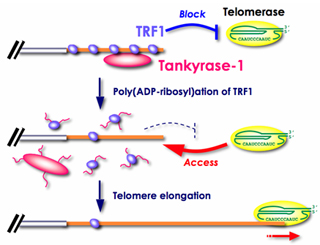
Tankyrase, a telomeric poly(ADP-ribose) polymerase (PARP), "acts as a positive regulator of telomere enlongation in vivo, apparently by inhibiting TRF1 [Index]. In general, PARP catalyzes the formation of poly(ADP-ribose) onto a protein acceptor using NAD+ as a substrate in response to DNA damage.
Long-term overexpression of tankyrase 1 in telomerase-positive human cells results in a gradual and progressive enlongation of telomeres. See "Overexpression of tankyrase 1 in telomerase-positive cells releases TRF1 from telomeres, resulting in telomere elongation." [2004], and H. Seimiya (2006),
The telomeric PARP, tankyrases, as targets for cancer therapy, British Journal of Cancer, 2006, 94, 341-345 [Figure 2].
Tankyrase 1 uses NAD as a stubstrate in poly(ADP-ribosylation) of TRF1, so NAD supplements [Images] may be useful when applying Tankyrase 1 to encourage hTERT transcription to activate telomerase.
Furthermore, nicotinamide
(niacinamide),
a form of Vitamin B3,
has been shown to boost
poly(ADP-ribose) polymerase
levels (Tammy M. Jackson, et. al., 1995).
Nicotinamide was used
to elevate PARP levels in experimental animals at 1 gram/kg dosage,
and was useful for upregulating NAD+ in the heart
at 500 mg/kg. "Phosphorylation
of tankyrase 1
results in upregulation of its intrinsic PARP activity."
(H. Seimiya,
2006). Phosphorylation is accomplished by insulin stimulation.
Tankyrase 1
is serine-phosphorylated by MAP kinases,
enhancing its telomeric PARP activity.
(Sbodio,
Lodish, and Chi, 2002).
"...Tankyrase is quantitatively phosphorylated on
certain serine residues
by MAP kinase upon stimulation with
insulin,
PDGF, and EGF."
(Chi
and Lodish, 2000).
Tankyrase 1 has more than 1 function in the cell. "Tankyrase 1 is a novel signaling target of mitogen-activated protein kinase (MAPK); it is stoichiometrically phosphorylated upon insulin stimulation. Phosphorylation enhances the poly(ADP-ribose) polymerase activity of tankyrase 1..." (Nai-Wen Chi and Harvey F. Lodish, 2000).
Phosphorylation allows tankyrase 1 to transduce MAPK signaling into poly(ADP-ribosyl)ation of effector proteins such as TRF1.
See upregulating tankyrase 1 mRNA transcription [Papers]. "TRF1 is a specific negative regulator of telomere length and its poly(ADP-ribosylation) by tankyrase 1 leads to the loss of telomere association and subsequent degradation by the ubiquitin/proteasome pathway (Chang et al. 2003, Smith et al. 1998)." (W.N.Keith and A.E.Bilsland, Targeting Telomerase: Therapeutic Options for Cancer Treatment, in K. Lenhard Rudolph, 2008, p.269.)
Perhaps adding an extra gene for tankyrase 1 with Zinc Finger Nuclease technology would be life-extending, if it did not much encourage carcinogenesis. Alternatively, tankyrase 1 plasmid expression vectors may be useful. See promoting tankyrase transcription. Evidently, going for a strong insulin spike after a bodybuilding workout (by using a specially formulated post-workout shake) can phosphorylate tankyrase, improving its performance as a telomerase activator. Furthermore, insulin itself may have this effect.
Gymnema Sylvestre (400-500 mg with a postworkout shake < 30 min after exercise) stimulates insulin secretion. Dextrose may be taken at 25-50 grams to spike insulin, along with whey protein or whey hydrolysates after a bodybuilding workout. Insulin secretion may also be improved by Fenugreek seeds, Fenugreek Extract [Images], or 4-hydroxyisoleucine [Images]. Tankyrase action on TRF1 can probably be promoted using Gymnema Sylvestre [Images] to produce insulin, phosphorylating Tankyrase 1 to increase its telomerase activation activity.
I note that a "tanky" race of men keeps its insulin high.
See TwinLabs
Creatine Nitrate3 Fuel.
See also Antisense
inhibition of Bcr-Abl/c-Abl synthesis promotes telomerase activity
and upregulates tankyrase in human leukemia cells,
FEBS letters,
2004, vol. 564, no1-2, pp. 73-84 [12 page(s) (article)].
Tankyrase 1 has a short reported half-life of just 2 hours.
Tankyrase 1 is overexpressed in human breast cancer,
so that novel
tankyrase inhibitors
(MST-312,
MST-295, and
MST-199) have been developed to function as
telomerase inhibitors for
application to anticancer therapy.
Furthermore, overexpression of
tankyrase 2, a related protein, results
in cell death (references from
H.
Seimiya, 2006). I add that there are also tankyrase-related proteins incorporating certain domains
of tankyrase 1 that perform like tankyrase 1 for purposes of opening telomere loops. There are also
nucleic acids (recombinant DNA molecules) that can bind to the acidic domain of a
TRF1. See De Lange, et al.,
TRF1 Binding Protein, Methods of Use Thereof,
US Patent
No. 6,277,613 B1, Aug. 21, 2001.
It seems clear that extra tankyrase 1 might be expressed by
supplying a DNA plasmid for transfection into the cell that is designed to encode tankyrase 1. Plasmids
with inducible promoters may be used, or perhaps
Plasmids of suitable half-life may be designed.
See Anderson, et al.,
US Patent 5,399,345.
Other compounds besides niacinamide might be used to improve NAD substrate levels for tankyrase 1 reactions with TRF1, and targeted phosphorylation of tankyrase 1 using substances besides insulin may be envisioned, perhaps vanadyl sulphate.
Also note that the effect of tankyrase 1 is different
on long telomeres (> 20 kbp) than on short telomeres,
where it acts to remove TRF1 for telomerase access (De Lange, et al, 2001). This because long telomeres
seem to support a coiled higher-order structure in the presence of sufficient TRF1. See
Smith, S., I. Giriat, A. Schmitt, and T. de Lange. (1998),
Tankyrase,
a poly(ADP-ribose) polymerase at human telomeres,
Science 282:1484-1487.
See also Cook, B. D., J. N. Dynek, W. Chang, G. Shostak, and S. Smith (2002), Role for the related poly(ADP-Ribose) polymerases tankyrase 1 and 2 at human telomeres, Mol. Cell. Biol, 22:332-342. Also of revelance is Ye J.Z., and de Lange, T. (2004), TIN2 is a tankyrase 1 PARP modulator in the TRF1 telomere length control complex, Nature Genetics, 36, 618-623. See also Nai-Wen Chi and Harvey F. Lodish (2000), Tankyrase Is a Golgi-associated Mitogen-activated Protein Kinase Substrate That Interacts with IRAP in GLUT4 Vesicles, Journal of Biological Chemistry, December 8, 2000, 275, 38437-38444. This is a reference for the phosphorylation of tankyrase 1 resulting in the upregulation of its activity. "In insulin-stimulated adipocytes, tankyrase 1 is phosphorylated at serine residues by the mitogen-activated protein kinase pathway." - After H. Seimiya, op.cit., referencing (Chi and Lodish, 2000), op.cit. Note that "...Tankyrase is quantitatively phosphorylated on certain serine residues by MAPK upon stimulation with insulin, PDGF, and EGF." (Chi and Lodish, 2000).
The phosphorylation of tankyrase 1 enhances its poly(ADP-ribo)sylation activity on TRF1 telomere loop closure protein, allowing t-loops to open for access by the telomerase holoenzyme. For application of tankyrase wisdom to cancer, see Hiroyuki Seimiya, Yukiko Muramatsu, Tomokazu Ohishi, and Takashi Tsuruo (2005), Tankyrase 1 as a target for telomere-directed molecular cancer therapeutics, Cancer Cell, Vol.7, issue 1, January 2005, pp.25-37. Also see Susan Smith and Titia de Lange (2000), Tankyrase promotes telomere enlongation in human cells, Current Biology, vol 10, no. 20, 1299-1302 with Susan Smith and Titia de Lange, TRF1 Binding Protein, Methods of Use Thereof, US Patent 6,277,613 B1. "Tankyrase does not contain a nuclear localization signal (NLS) and transfected tankyrase is excluded from the nucleus unless it is co-transfected with TRF1.... (An NLS can be added to its amino terminus to produce nuclear-localized tankyrase (FN-tankyrase))... Tankyrase releases TRF1 from telomeres in a reaction that depends on its PARP domain".
Doxycyclin
Presence or absence of telomere growth can depend on the presence of doxycyclin
[Links/doxycyclin,
Images,
Papers,
Patents,
Books;
Links/doxycyclin and telomere growth,
Images,
Papers,
Patents,
Books].
Tankyrase, a telomeric poly(ADP-ribose) polymerase (PARP), "acts as a positive regulator of telomere enlongation in vivo, apparently by inhibiting TRF1 [Index]. In general, PARP catalyzes the formation of poly(ADP-ribose) onto a protein acceptor using NAD+ as a substrate in response to DNA damage.
Long-term overexpression of tankyrase 1 in telomerase-positive human cells results in a gradual and progressive enlongation of telomeres. See "Overexpression of tankyrase 1 in telomerase-positive cells releases TRF1 from telomeres, resulting in telomere elongation." [2004], and H. Seimiya (2006),
The telomeric PARP, tankyrases, as targets for cancer therapy, British Journal of Cancer, 2006, 94, 341-345 [Figure 2].
Tankyrase 1 uses NAD as a stubstrate in poly(ADP-ribosylation) of TRF1, so NAD supplements [Images] may be useful when applying Tankyrase 1 to encourage hTERT transcription to activate telomerase.
Tankyrase 1 has more than 1 function in the cell. "Tankyrase 1 is a novel signaling target of mitogen-activated protein kinase (MAPK); it is stoichiometrically phosphorylated upon insulin stimulation. Phosphorylation enhances the poly(ADP-ribose) polymerase activity of tankyrase 1..." (Nai-Wen Chi and Harvey F. Lodish, 2000).
Phosphorylation allows tankyrase 1 to transduce MAPK signaling into poly(ADP-ribosyl)ation of effector proteins such as TRF1.
See upregulating tankyrase 1 mRNA transcription [Papers]. "TRF1 is a specific negative regulator of telomere length and its poly(ADP-ribosylation) by tankyrase 1 leads to the loss of telomere association and subsequent degradation by the ubiquitin/proteasome pathway (Chang et al. 2003, Smith et al. 1998)." (W.N.Keith and A.E.Bilsland, Targeting Telomerase: Therapeutic Options for Cancer Treatment, in K. Lenhard Rudolph, 2008, p.269.)
Perhaps adding an extra gene for tankyrase 1 with Zinc Finger Nuclease technology would be life-extending, if it did not much encourage carcinogenesis. Alternatively, tankyrase 1 plasmid expression vectors may be useful. See promoting tankyrase transcription. Evidently, going for a strong insulin spike after a bodybuilding workout (by using a specially formulated post-workout shake) can phosphorylate tankyrase, improving its performance as a telomerase activator. Furthermore, insulin itself may have this effect.
Gymnema Sylvestre (400-500 mg with a postworkout shake < 30 min after exercise) stimulates insulin secretion. Dextrose may be taken at 25-50 grams to spike insulin, along with whey protein or whey hydrolysates after a bodybuilding workout. Insulin secretion may also be improved by Fenugreek seeds, Fenugreek Extract [Images], or 4-hydroxyisoleucine [Images]. Tankyrase action on TRF1 can probably be promoted using Gymnema Sylvestre [Images] to produce insulin, phosphorylating Tankyrase 1 to increase its telomerase activation activity.
Other compounds besides niacinamide might be used to improve NAD substrate levels for tankyrase 1 reactions with TRF1, and targeted phosphorylation of tankyrase 1 using substances besides insulin may be envisioned, perhaps vanadyl sulphate.
See also Cook, B. D., J. N. Dynek, W. Chang, G. Shostak, and S. Smith (2002), Role for the related poly(ADP-Ribose) polymerases tankyrase 1 and 2 at human telomeres, Mol. Cell. Biol, 22:332-342. Also of revelance is Ye J.Z., and de Lange, T. (2004), TIN2 is a tankyrase 1 PARP modulator in the TRF1 telomere length control complex, Nature Genetics, 36, 618-623. See also Nai-Wen Chi and Harvey F. Lodish (2000), Tankyrase Is a Golgi-associated Mitogen-activated Protein Kinase Substrate That Interacts with IRAP in GLUT4 Vesicles, Journal of Biological Chemistry, December 8, 2000, 275, 38437-38444. This is a reference for the phosphorylation of tankyrase 1 resulting in the upregulation of its activity. "In insulin-stimulated adipocytes, tankyrase 1 is phosphorylated at serine residues by the mitogen-activated protein kinase pathway." - After H. Seimiya, op.cit., referencing (Chi and Lodish, 2000), op.cit. Note that "...Tankyrase is quantitatively phosphorylated on certain serine residues by MAPK upon stimulation with insulin, PDGF, and EGF." (Chi and Lodish, 2000).
The phosphorylation of tankyrase 1 enhances its poly(ADP-ribo)sylation activity on TRF1 telomere loop closure protein, allowing t-loops to open for access by the telomerase holoenzyme. For application of tankyrase wisdom to cancer, see Hiroyuki Seimiya, Yukiko Muramatsu, Tomokazu Ohishi, and Takashi Tsuruo (2005), Tankyrase 1 as a target for telomere-directed molecular cancer therapeutics, Cancer Cell, Vol.7, issue 1, January 2005, pp.25-37. Also see Susan Smith and Titia de Lange (2000), Tankyrase promotes telomere enlongation in human cells, Current Biology, vol 10, no. 20, 1299-1302 with Susan Smith and Titia de Lange, TRF1 Binding Protein, Methods of Use Thereof, US Patent 6,277,613 B1. "Tankyrase does not contain a nuclear localization signal (NLS) and transfected tankyrase is excluded from the nucleus unless it is co-transfected with TRF1.... (An NLS can be added to its amino terminus to produce nuclear-localized tankyrase (FN-tankyrase))... Tankyrase releases TRF1 from telomeres in a reaction that depends on its PARP domain".
Doxycyclin
NAD+
The form of nicotine found in mucuna is Nicotine Adenine Dinucleotide: Nicotinamide adenine dinucleotide, abbreviated NAD+, is a coenzyme found in all living cells.
The compound is a dinucleotide, since it consists of two nucleotides joined through their phosphate groups. One nucleotide contains an adenine base and the other nicotinamide.
The enzymes that make and use NAD+ and NADH are important in both current pharmacology and the research into future treatments for disease.[63]
Drug design and drug development exploits NAD+ in three ways: as a direct target of drugs, by designing enzyme inhibitors or activators based on its structure that change the activity of NAD-dependent enzymes, and by trying to inhibit NAD+ biosynthesis.[64]
The coenzyme NAD+ is not itself currently used as a treatment for any disease. However, it is potentially useful in the therapy of neurodegenerative diseases such as Alzheimer'sand Parkinson disease.[2]
Evidence on the use of NAD+ in neurodegeneration is mixed; studies in mice are promising,[65] whereas a placebo-controlled clinical trial failed to show any effect.[66](from: http://en.wikipedia.org/wiki/NADH)
NADH stands for "nicotinamide adenine dinucleotide (NAD) + hydrogen (H)." This chemical occurs naturally in the body and plays a role in the chemical process that generates energy. People use NADH supplements as medicine.
NADH is used for improving mental clarity, alertness, concentration, and memory; as well as for treating Alzheimer’s disease. Because of its role in energy production, NADH is also used for improving athletic endurance and treating chronic fatigue syndrome (CFS).
Some people use NADH for treating high blood pressure, high cholesterol, jet lag, depression, and Parkinson’s disease; boosting the immune system; opposing alcohol’s effects on the liver and the hormone testosterone; reducing signs of aging; and protecting against the side effects of an AIDS drug called zidovudine (AZT).
Healthcare providers sometimes give NADH by intramuscular (IM) or intravenous (IV) injection for Parkinson's disease and depression.
Safety of NADH: NADH seems safe for most people when used appropriately and short-term, up to 12 weeks. Most people do not experience any side effects when taking the recommended amount each day, which is 10 mg. (from http://www.webmd.com/vitamins-supplements/ingredientmono-1016-NADH.aspx?activeIngredientId=1016&activeIngredientName=NADH)
More on NADH: Neuroprotective effects of the antiparkinson drug Mucuna pruriens
http://onlinelibrary.wiley.com/doi/10.1002/ptr.1514/abstract
Human Study on Mucuna:
Mucuna pruriens in Parkinson’s disease: a double blind clinical and pharmacological study
http://jnnp.bmj.com/content/75/12/1672.abstract
Methods: Eight Parkinson’s disease patients with a short duration L-dopa response and on period dyskinesias completed a randomised, controlled, double blind crossover trial. Patients were challenged with single doses of 200/50 mg LD/CD, and 15 and 30 g of mucuna preparation in randomised order at weekly intervals. L-Dopa pharmacokinetics were determined, and Unified Parkinson’s Disease Rating Scale and tapping speed were obtained at baseline and repeatedly during the 4 h following drug ingestion. Dyskinesias were assessed using modified AIMS and Goetz scales.
Results: Compared with standard LD/CD, the 30 g mucuna preparation led to a considerably faster onset of effect (34.6 v 68.5 min; p = 0.021), reflected in shorter latencies to peak L-dopa plasma concentrations. Mean on time was 21.9% (37 min) longer with 30 g mucuna than with LD/CD (p = 0.021); peak L-dopa plasma concentrations were 110% higher and the area under the plasma concentration v time curve (area under curve) was 165.3% larger (p = 0.012). No significant differences in dyskinesias or tolerability occurred.
Conclusions: The rapid onset of action and longer on time without concomitant increase in dyskinesias on mucuna seed powder formulation suggest that this natural source of L-dopa might possess advantages over conventional L-dopa preparations in the long term management of PD. Assessment of long term efficacy and tolerability in a randomised, controlled study is warranted.
Mucuna is neuroprotective:
Anti-parkinson botanical Mucuna pruriens prevents levodopa induced plasmid and genomic DNA damage
http://onlinelibrary.wiley.com/doi/10.1002/ptr.2219/abstract
Levodopa is considered the ‘gold standard’ for the treatment of Parkinson's disease. However, a serious concern is dyskinesia and motor fluctuation that occurs after several years of use. In vitro experiments have shown that in the presence of divalent copper ions, levodopa may induce intense DNA damage. Mucuna pruriens cotyledon powder (MPCP) has shown anti-parkinson and neuroprotective effects in animal models of Parkinson's disease that is superior to synthetic levodopa. In the present study two different doses of MPCP protected both plasmid DNA and genomic DNA against levodopa and divalent copper-induced DNA strand scission and damage. It exhibited chelation of divalent copper ions in a dose-dependent manner. The copper chelating property may be one of the mechanisms by which MPCP exerts its protective effects on DNA.
The compound is a dinucleotide, since it consists of two nucleotides joined through their phosphate groups. One nucleotide contains an adenine base and the other nicotinamide.
The enzymes that make and use NAD+ and NADH are important in both current pharmacology and the research into future treatments for disease.[63]
Drug design and drug development exploits NAD+ in three ways: as a direct target of drugs, by designing enzyme inhibitors or activators based on its structure that change the activity of NAD-dependent enzymes, and by trying to inhibit NAD+ biosynthesis.[64]
The coenzyme NAD+ is not itself currently used as a treatment for any disease. However, it is potentially useful in the therapy of neurodegenerative diseases such as Alzheimer'sand Parkinson disease.[2]
Evidence on the use of NAD+ in neurodegeneration is mixed; studies in mice are promising,[65] whereas a placebo-controlled clinical trial failed to show any effect.[66](from: http://en.wikipedia.org/wiki/NADH)
NADH stands for "nicotinamide adenine dinucleotide (NAD) + hydrogen (H)." This chemical occurs naturally in the body and plays a role in the chemical process that generates energy. People use NADH supplements as medicine.
NADH is used for improving mental clarity, alertness, concentration, and memory; as well as for treating Alzheimer’s disease. Because of its role in energy production, NADH is also used for improving athletic endurance and treating chronic fatigue syndrome (CFS).
Some people use NADH for treating high blood pressure, high cholesterol, jet lag, depression, and Parkinson’s disease; boosting the immune system; opposing alcohol’s effects on the liver and the hormone testosterone; reducing signs of aging; and protecting against the side effects of an AIDS drug called zidovudine (AZT).
Healthcare providers sometimes give NADH by intramuscular (IM) or intravenous (IV) injection for Parkinson's disease and depression.
Safety of NADH: NADH seems safe for most people when used appropriately and short-term, up to 12 weeks. Most people do not experience any side effects when taking the recommended amount each day, which is 10 mg. (from http://www.webmd.com/vitamins-supplements/ingredientmono-1016-NADH.aspx?activeIngredientId=1016&activeIngredientName=NADH)
More on NADH: Neuroprotective effects of the antiparkinson drug Mucuna pruriens
http://onlinelibrary.wiley.com/doi/10.1002/ptr.1514/abstract
Abstract
Mucuna pruriens possesses significantly higher antiparkinson activity compared with levodopa in the 6-hydroxydopamine (6-OHDA) lesioned rat model of Parkinson's disease. The present study evaluated the neurorestorative effect of Mucuna pruriens cotyledon powder on the nigrostriatal tract of 6-OHDA lesioned rats. Mucuna pruriens cotyledon powder significantly increased the brain mitochondrial complex-I activity but did not affect the total monoamine oxidase activity (in vitro). Unlike synthetic levodopa treatment, Mucuna prurienscotyledon powder treatment significantly restored the endogenous levodopa, dopamine, norepinephrine and serotonin content in the substantia nigra. Nicotine adenine dinucleotide (NADH) and coenzyme Q-10, that are shown to have a therapeutic benefit in Parkinson's disease, were present in the Mucuna pruriens cotyledon powder. Earlier studies showed that Mucuna pruriens treatment controls the symptoms of Parkinson's disease. This additional finding of a neurorestorative benefit by Mucuna pruriens cotyledon powder on the degenerating dopaminergic neurons in the substantia nigra may be due to increased complex-I activity and the presence of NADH and coenzyme Q-10.Human Study on Mucuna:
Mucuna pruriens in Parkinson’s disease: a double blind clinical and pharmacological study
http://jnnp.bmj.com/content/75/12/1672.abstract
Abstract
Background: The seed powder of the leguminous plant, Mucuna pruriens has long been used in traditional Ayurvedic Indian medicine for diseases including parkinsonism. We have assessed the clinical effects and levodopa (L-dopa) pharmacokinetics following two different doses of mucuna preparation and compared them with standard L-dopa/carbidopa (LD/CD).Methods: Eight Parkinson’s disease patients with a short duration L-dopa response and on period dyskinesias completed a randomised, controlled, double blind crossover trial. Patients were challenged with single doses of 200/50 mg LD/CD, and 15 and 30 g of mucuna preparation in randomised order at weekly intervals. L-Dopa pharmacokinetics were determined, and Unified Parkinson’s Disease Rating Scale and tapping speed were obtained at baseline and repeatedly during the 4 h following drug ingestion. Dyskinesias were assessed using modified AIMS and Goetz scales.
Results: Compared with standard LD/CD, the 30 g mucuna preparation led to a considerably faster onset of effect (34.6 v 68.5 min; p = 0.021), reflected in shorter latencies to peak L-dopa plasma concentrations. Mean on time was 21.9% (37 min) longer with 30 g mucuna than with LD/CD (p = 0.021); peak L-dopa plasma concentrations were 110% higher and the area under the plasma concentration v time curve (area under curve) was 165.3% larger (p = 0.012). No significant differences in dyskinesias or tolerability occurred.
Conclusions: The rapid onset of action and longer on time without concomitant increase in dyskinesias on mucuna seed powder formulation suggest that this natural source of L-dopa might possess advantages over conventional L-dopa preparations in the long term management of PD. Assessment of long term efficacy and tolerability in a randomised, controlled study is warranted.
Mucuna is neuroprotective:
Anti-parkinson botanical Mucuna pruriens prevents levodopa induced plasmid and genomic DNA damage
http://onlinelibrary.wiley.com/doi/10.1002/ptr.2219/abstract
Levodopa is considered the ‘gold standard’ for the treatment of Parkinson's disease. However, a serious concern is dyskinesia and motor fluctuation that occurs after several years of use. In vitro experiments have shown that in the presence of divalent copper ions, levodopa may induce intense DNA damage. Mucuna pruriens cotyledon powder (MPCP) has shown anti-parkinson and neuroprotective effects in animal models of Parkinson's disease that is superior to synthetic levodopa. In the present study two different doses of MPCP protected both plasmid DNA and genomic DNA against levodopa and divalent copper-induced DNA strand scission and damage. It exhibited chelation of divalent copper ions in a dose-dependent manner. The copper chelating property may be one of the mechanisms by which MPCP exerts its protective effects on DNA.
raw food restaurants
Choco & Chaga
Suvantokatu 2, 80100 Joensuu, Finland
open 12-15 PM
Choco & Chaga tarjoilee mainiointa raakasuklaata sekä itsekerätystä pakurista haudutettua teetä idyllisesti puutalokorttelin sisäpihalla.
Suvantokatu 2, 80100 Joensuu, Finland
open 12-15 PM
Choco & Chaga tarjoilee mainiointa raakasuklaata sekä itsekerätystä pakurista haudutettua teetä idyllisesti puutalokorttelin sisäpihalla.
arachidonic acid
Arachidonic acid, ARA/AA
Arachidonic acid stimulates the production of pro-inflammatory prostaglandins and leucotrienes through COX (cyclogenase) and LOX (liposygenase) enzyme conversion process.
Natural 5-LOX enzyme convert arachidonic acid to 5-HETE ( which can ignite prostate cancer ).
Natural 5-LOX inhibitors: Saw palmetto, ginger, curcumin and boswellia.
Natural COX-2 inhibitors: holy basil, berberine , curcumin, EGCG, ginger, common hop, fish oil, oregano, quercetin, resveratrol, rosemary, Chinese skullcap, vitamins A, E
Natural NF-kB inhibitors: allicin, curcumin, EGCG, genistein, gingko biloba, melatonin, quercetin, resveratrol, silymarin, sulphoraphane, vitamins A, C, E

Carnivorous animals can't readily convert linoleic acid (in plants) to arachidonic acid. Herbivores and humans readily convert linoleic acid to arachidonic acid.
Modulation of arachidonic acid metabolism by curcumin and related beta-diketone derivatives: effects on cytosolic phospholipase A(2), cyclooxygenases and 5-lipoxygenase
Arachidonic acid stimulates the production of pro-inflammatory prostaglandins and leucotrienes through COX (cyclogenase) and LOX (liposygenase) enzyme conversion process.
Natural 5-LOX enzyme convert arachidonic acid to 5-HETE ( which can ignite prostate cancer ).
Natural 5-LOX inhibitors: Saw palmetto, ginger, curcumin and boswellia.
Natural COX-2 inhibitors: holy basil, berberine , curcumin, EGCG, ginger, common hop, fish oil, oregano, quercetin, resveratrol, rosemary, Chinese skullcap, vitamins A, E
Natural NF-kB inhibitors: allicin, curcumin, EGCG, genistein, gingko biloba, melatonin, quercetin, resveratrol, silymarin, sulphoraphane, vitamins A, C, E

Carnivorous animals can't readily convert linoleic acid (in plants) to arachidonic acid. Herbivores and humans readily convert linoleic acid to arachidonic acid.
Modulation of arachidonic acid metabolism by curcumin and related beta-diketone derivatives: effects on cytosolic phospholipase A(2), cyclooxygenases and 5-lipoxygenase
Shungite
Shungite has really been brought to the worlds attention because of its amazing properties and uniqueness as a crystal. It looks similar to coal and leaves black dust on the hands when handled. Shungite is found in one place called Zazhoginskoye near Lake Onega in the Shunga region of Karelia, North West of Russia.
Shungite is unique in that it contains Fullerenes. Fullerenes are a form of carbon molecule that is neither graphite nor diamond. They consist of a spherical, ellipsoid, or cylindrical arrangement of dozens of carbon atoms. Fullerenes were named after Richard Buckminster Fuller, an architect known for the design of geodesic domes which resemble spherical fullerenes in appearance. A spherical fullerene looks like a soccer ball, and are often called "buckyballs," whereas cylindrical fullerenes are known as "buckytubes" or "nanotubes." Shungite is a mineral black carbon.
EMFs and Shungite
Shungite has been used by the military for EMF protection. It is excellent for high frequency emissions and is used in protective EMF paints and patented designs for aircraft. It is a crystal with a lot of potential.
Shungite and water
Shungite is used in some large city reservoirs to clean up the water. It is also sold for home use to use in the bottom of water jugs for sparkling clean water.
Shungite and Healing
Shungite has been found to aid balancing and healing by absorbing negative energy output. It aids the body in its healing and helps restore emotional balance.
Cleaning Shungite
Personal Shungite needs cleaning every couple of days and more so if there have been a lot of emotional issues. It also has to be cleaned or grounded out if used for EMFs -for example some people sell it for mobile phone use. After trialling it here at The Blue Sun we came to the conclusion that it really does a good job absorbing EMFs and negative energies BUT it quickly becomes full and if it is not thoroughly cleaned out it will start to radiate whatever it has absorbed. People trialling the personal pieces of Shungite began to feel tense and uncomfortable with the Shungite on the second day of carrying it in a pocket. Immediate relief was felt once the Shungite was removed. Fresh pieces of Shungite made people feel good, energised and balanced. However..Shungite mixed into orgone does not need cleaning.
Shungite and Orgone
Shungite and Orgone were made for each other. Orgone absorbs and transmutes energies. Shungite absorbs and needs clearing once it is full. Shungite powder mixed into resin with powdered metal and gold leaf makes a very powerful piece of Orgone because in this partnership the Shungite is constantly cleared and the absorption of the orgone is increased. This is to date one of the most powerful Orgone energy combinations we have found. They Rock!
Telomerase Activators
(23) CGK733
CGK733 was identified by a high-throughput phenotypic screen with automated imaging used in high-thoughput testing bioscience technique [Index/High Throughput Screening] employing a magnetic nanoprobe technology, magnetism-based interaction capture (MAGIC). CGK733 can produce 25% life extension by providing 20 more cell divisions. Its precise mechanism differs from telomerase activation: it revives senescent cells, working "by blocking a protein checkpoint involved in sensing and slowing down cells in response to DNA damage. Although Kim showed that cells whose aging was reversed by CGK733 didn't develop chromosomal abnormalities, the long-term effect of blocking DNA repair mechanisms could lead to cancer."
(24) Hypoxia-inducible factor 1 (HIF-1)
"The heterodimeric transcription factor HIF-1 is composed of the two subunits HIF-1alpha and HIF-1beta. While HIF-1beta is constantly present in the nucleus, HIF-1alpha levels are affected by changes in the cellular oxygen partial pressure (pO2)." (Wirth, Beerlage, et.al, 2010). HIF-1 (hypoxia-inducible factor 1) activates telomerase [Article, Links, Images, Papers, Books]. "Hypoxia activates telomerase via transcriptional activation of hTERT, and HIF-1 plays a critical role as a transcription factor." See [Wikipedia/Hypoxia-induced factors, Images/HIF-1, Links/HIF-1 molecule; toxicity]. Since HIF-1 has a sequence length of 836 amino acids and a molecular weight 93.5189 kD, it might possibly be transfected by electroporation, given by injection, or be administered in liposomes suitable for endocytosis of drugs, or have its transcription activated by some other agent. Also see drugs promoting the expression of HIF-1 [Images, Papers, Patents, Books]. Exercise elevates HIF-1, as it tends to induce hypoxia. Note that tumor suppressor genes promote the expression of HIF-1. The hTERT promoter and the hTR promoter both feature Hypoxia Response Element (HRE) sites for binding the transcription factor HIF-1 which overlap E-boxes for binding c-Myc. "HIF-1 is known to bind to HRE sites in the promoters of a variety of genes where it recruits the basal transcriptional machinery and transcriptional coactivators such as P300/CBP to induce transcription" (C.J. Cairney and W.N. Keith, 2007). See also C.J. Anderson, S.F. Hoare, M. Ashcroft, A.E. Bilsland, W.N. Keith, Hypoxic regulation of telomerase gene expression by transcriptional and post-transcriptional mechanisms, Oncogene 25 (2006) 61-69. Note that Ginkgo Biloba [Images] and Ginkgolides upregulate HIF-1 expression (Li Z, Ya K, Xiao-Mei W, et.al, 2008). Thirty minutes of exercise upregulates PDGF (1.55-fold), and also HIF-1 (hypoxia-inducible factor-I) (2.40-fold). Both are telomerase activators. See Peter H. Connolly, Vincent J. Caiozzo, Frank Zaldivar, Dan Nemet, Jennifer Larson, She-pin Hung, J. Denis Heck, G. Wesley Hatfield and Dan M. Cooper (2004), Effects of exercise on gene expression in human peripheral blood mononuclear cells, Journal of Applied Physiology, October 2004, vol. 97 no. 4 1461-1469.
See Ling Zhang, Qian Liu, Lin Lu, Xiaoping Zhao, Xiumei Gao and Yi Wang (2011), Astragaloside IV Stimulates Angiogenesis and Increases Hypoxia-Inducible Factor-1alpha Accumulation via Phosphatidylinositol 3-Kinase/Akt Pathway, The Journal of Pharmacology and Experimental Therapeutics, August 2011, 338(2), 485-491. "Results indicate that astragaloside IV promoted cell proliferation and stimulated HIF-1alpha accumulation during hypoxia. Mechanism studies revealed that astragaloside IV did not affect the degradation of HIF-1alpha protein or the level of HIF-1alpha mRNA. In contrast, astragaloside IV apparently activated the phosphatidylinositol 3-kinase (PI3K)/Akt pathway, which regulates HIF-1alpha protein synthesis." Note that HIF-1 activates the transcription of hTERT mRNA. Evidently, exercise to produce hypoxia improves the telomerase activation obtained when using astragaloside IV, the main active factor in astragalus extract. Note that the PI3K/AKT pathway phosphorlyates cytoplasmic hTERT translated from hTERT mRNA for import into the nucleus.
Diosgenin [HIF-1, Wikipedia/Diosgenin; Links/Diosgenin, Images, Papers, Patents, Wikipedia/Diosgenin, Ray Sahelion/Diosgenin; Diosgenin molecule; toxicity]: See Yen and Su, et al, 2005, Diosgenin induces HIF-1 activation and angiogenesis through estrogen receptor-related PI3K/Akt and p38 MAPK pathways in osteoblasts, Molecular Pharmacology Fast Forward, July 5, 2005. Diosgenin is used as a sexual stimulant and breast enlarger and is thought to offer good stability against breast cancer. It is pictured as a phytoestrogen replacement for progesterone. It may be derived from Wild Yam [Links, Images, Papers, Patents, Books]. See extraction of Diosgenin from the Wild Yam [Images, Papers, Patents, Books]. Diosgenin is also found in Fenugreek seeds. See Papers/the hTERT activation pathway for HIF-1 or Papers/the HIF-1 hTERT activation pathway, estrogen receptor-related PI3/Akt pathways, estrogen receptor-related p38 MAPK pathways, and phytoestrogen pathways. See also she male longevity and Index/MAPK pathway. Progesterone gets some of its hTERT transcriptional effects via the MAPK pathway. See also MAP Kinase pathway telomerase activators and PI3K/AKT Kinase pathway telomerase activators.
HIF-1 (continued)
"HIF-1 is expressed in all cell types and functions as a master regulator of oxygen homeostasis by playing critical roles in both embryonic development and postnatal physiology. HIF-1 has been identified in all metazoan species that have been analyzed from Caenorhabditis elegans to Homo sapiens (organisms whose cell numbers differ by more than 10 orders of magnitude), suggesting that the appearance of HIF-1 represented an adaptation that was essential to metazoan evolution.... The expression of over 70 genes is known to be activated at the transcriptional level by HIF-1, and specific HIF-1 binding sites have been identified for many of these genes.... The HIF-1beta subunit is constitutively expressed, whereas the expression and activity of the HIF-1alpha subunit are precisely regulated by the cellular O2 concentration." - from Craig L. Semenza (2004), Hydroxylation of HIF-1: Oxygen Sensing at the Molecular Level, Physiology August 2004;19(4):176-182. Note that FOXO4 down-regulates HIF1A (Wikipedia/HIF1A). Thus FOXO4 inhibitors such as those promoting Akt transcription factor, which phosphorylates FOXO to create a binding site for chaparone proteins (14-3-3 proteins) sequestering FOXO away from the nucleus, may be used to improve HIF1A activity. See Index/PI3-Kinase/Akt Pathway and FOXO. Certain supplements improving the expression of AKT transcription factor might be taken prior to exercise to improve HIF-1A staying power, which would act to improve hTERT transcription from HIF-1 binding to the hTERT promoter. Resveratrol might not be the best because it condenses chromatin, relying on phosphorylation of cytoplasmic hTERT to elevate nuclear hTERT activity rather than hTERT transcription. Searches suggest that leucine [Images] or its metabolite beta-hydroxy-beta-methylbutyrate [Images], which stimulates muscular hypertrophy, may be useful for improving the expression of AKT.
"Hypoxia rapidly enhanced HIF-1α mRNA levels and HIF-1α promoter activity. Further, inhibition of the PI3K/AKT but not ERK1/2 pathway blocked the hypoxia-dependent induction of HIF-1α mRNA and HIF-1α promoter activity, suggesting involvement of a PI3K/AKT regulated transcription factor. Interestingly, hypoxia also induced NFκB nuclear translocation and activity. In line, expression of the NFκB subunits p50 and p65 enhanced HIF-1α mRNA levels whereas blocking of NFκB by an IκB mutant attenuated HIF-1α mRNA induction by hypoxia." - Rachida S. BelAiba, Steve Bonello, Christian Zähringer, Stefanie Schmidt, John Hess, Thomas Kietzmann1, Agnes Görlach (2007), Hypoxia upregulates HIF-1alpha transcription by involving PI-3 kinase and NFKB in pulmonary artery smooth muscle cells, Mol Biol Cell, 2007.
(25) Mre11 protein
Mre11 protein has been noted to lengthen telomeres in plant cells and in human cells. (Bundock and Hooykaas, 2002.) See also [Images/Mre11 protein and telomeres in human cells; Images/Mre11 protein molecule]. See supplements promoting Mre11 protein. Perhaps Mre11 protein can be taken in a liposomal spray, like IGF-1. Its gene may be transfected in plasmids or via viral vectors such as the adenovirus or the Adeno-Associated viruses, if a permanant extra gene for Mre11 protein is not harmful. The role of the Mre11 protein in telomere function is detailed in the pathway analyses for telomere function given in Qiagen/Telomere Extension by Telomerase and Qiagen/Telomerase components in cell signaling. See also Matsutani N, Yokozaki H, Tahara E, Tahara H, Kuniyasu H, Kitadai Y, Haruma K, Chayama K, Tahara E, Yasui W. (2001), Expression of MRE11 complex (MRE11, RAD50, NBS1) and hRap1 and its relation with telomere regulation, telomerase activity in human gastric carcinomas, Pathobiology, 2001;69(4):219-24. Kristina Trenz, Eloise Smith, Sarah Smith, and Vincenzo Costanzo (2006), ATM and ATR promote Mre11 dependent restart of collapsed replication forks and prevent accumulation of DNA breaks, EMBO J. 2006 April 19; 25(8): 1764–1774. See Papers/the hTERT activation pathway for Mre11 protein or Papers/the Mre11 protein hTERT activation pathway.
(26) Ependymin peptide
Ependymin Peptide Mimetics: a 14-amino acid ependymin peptide was effective in activating telomerase. Ependymin peptide is a secretory protein found in the cerobrospinal fluid and extracellular fluid of goldfish brains. Ceremedix, Inc. makes the 14-amino-acid ependymin peptide, which has the sequence ESCKKETLQFRKHL, or Glu-Ser-Cys-Lys-Lys-Glu-Thr-Leu-Gln-Phe-Arg-Lys-His-Leu. Such a compact peptide can probably be conveniently administered in liposomes suitable for cellular endocytosis, perhaps as an oral liposomal spray or skin cream. Pehaps it can be easily prepared as a secretory protein via programming of E. Coli with engineered DNA plasmids, or by using CHO or HEK293 cells. See protein production. It might also be convenient to prepare ependymin peptide plasmids for liposomal transfection, using a suitably compact plasmid vector and periodic administration of the probably degradable plasmid vector. See (Hirsch, Erica, 2005. Telomerase Activity and Telomere Lengths in Fibroblast Cells Treated with Ependymin Peptide Mimetics). See the hTERT activation pathway for ependymin or the ependymin hTERT activation pathway.
(27) Protein kinase C [GeneCards/PRKCI, Wikipedia, Links, Images, Papers, Patents, Books; Links/supplements promoting Protein Kinase C, WikiGenes/Protein Kinase C, WikiGenes/Protein Kinase C activates telomerase; Images/Protein Kinase C molecule; toxicity]. Protein Kinase C is said to activate telomerase [Links, Images, Papers, Patents, Books]. (Rumiana Bakalovaa, Hideki Ohba, et al, (2003), Cross-talk between Bcr-Abl tyrosine kinase, protein kinase C and telomerase - a potential reason for resistance to Glivec in chronic myelogenous leukaemia). "In peripheral blood mononuclear cells, telomerase activity is enhanced by Protein Kinase C activator phorbol myristate acetate, whereas this activation is inhibited by the Protein Kinase C inhibitor bisindolymaeimide I." - Yu-Sheng Kong, Woodring E. Wright and Jerry W. Shay (2002), Human Telomerase and its Regulation, Microbiology and Molecular Biology Reviews, Sept. 2002, pp. 407-425, and associated papers. See Protein Kinase C activator phorbol myristate acetate [Links, Images, Papers, Patents, Books]. Phorbol myristate acetate is a potent tumor promoter used in tests. However, perhaps it can be used effectively in cyclic treatment, as all telomerase activators are (weakly) tumor promoters as a consequence of interferring with telomerase inhibitors that squelch tumor cells with apoptosis. Perhaps Protein kinase C can be applied in a liposomal spray or skin cream for telomerase activation, or transfected in plasmids. See Papers/the hTERT activation pathway for protein kinase C or Papers/the protein kinase C hTERT activation pathway.
(28) Retinoic acid [Telomerase Inhibitors/Retinoic Acid, Links; Links/retinoic acid telomerase, WikiGenes/Retinoic Acid; Images/retinoic acid molecule; toxicity]. Retinoic acid is a telomerase inhibitor on our list, but by limiting p16INK4A it can increase the time a cell can express telomerase before reaching replicative senescence. Retinoic acid was reported to maintain telomerase activity in human oral keratinocytes [You, et al., 2000, according to Michael Fossel, Cells, Aging, and Human Disease, p.158.]. However, retinoic acid has also been reported to down-regulate telomerase by Z Ding, AG Green, X Yang, G Chernenko, SC Tang, et al., Retinoic Acid Inhibits Telomerase Activity and Downregulates Expression but Does Not Affect Splicing, Experimental Cell Research, 2002. See also Yong-Ouk You, Gene Lee and Byung-Moo Min, 2000. Retinoic Acid Extends the in Vitro Life Span of Normal Human Oral Keratinocytes by Decreasing p16INK4A Expression and Maintaining Telomerase Activity, Biochemical and Biophysical Research Communications, Volume 268, Issue 2, 16 February 2000, Pages 268-274. See also Maurelli, Zambruno, et al. (2006), Inactivation of p16INK4a (inhibitor of cyclin-dependent kinase 4A) Immortalizes Primary Human Keratinocytes By Maintaining Cells in the Stem Cell Compartment, The FASEB Journal, 2006;20:1516-1518.
[Papers/Retinoic acid and telomerase activation].
(29) DMSO (Dimethyl Sulfoxide) [Telomerase Inhibitors/Dimethyl Sulfoxide (DMSO), Links, Images, Papers, Patents, Books, WikiGenes/DMSO; toxicity] exposure may trigger transient telomerase expression [Papers, (Alfonso-De Matte, et al., 2001, Ultraviolet Irradiation- and Dimethyl Sulfoxide-Induced Telomerase Activity in Ovarian Epithelial Cell Lines)]. However, DMSO is also listed as our telomerase inhibitor (46). Telomerase activation by telomerase activators was measured by Geron in their 2005 patent Compositions and Methods for Increasing Telomerase Activity using comparisons with a DMSO control for a standard, which would have been comparing with repressed transcription of hTERT. DMSO was shown as telomerase activating at the 100 level in US Patent 7,846,904 B2, Dec.7,2010., and its activation level was compared to EGF and other telomerase-activating formulations using the TRAP assay for telomerase activity. DMSO has been suggested as a delivery vehicle for small molecule telomerase activators, although when applied to the skin it leaves a garlic-like taste in the mouth.
(30) Epidermal growth factor (EGF) [GeneCards/EGF, Wikipedia, Links, Images, Video, Papers, Patents, Books; polypeptide diagram, Biocara Pathways, Wikigenes/EGF, WikiGenes/Epidermal Growth Factor, WikiGenes/EGF and hTERT activation; Images/Epidermal Growth Factor molecule; Iron Dragon Epidermal Growth Factor (EGF), toxicity; Wikipedia/Epidermal_growth_factor_receptor, Links/Epidermal Growth Factor Receptor, Images, Papers, Patents, Books]. Epidermal Growth Factor (EGF) activates telomerase [Papers] in epidermal keratinocytes. EGF has been patented for application to cosmetics (Video). Sometimes EGF is mixed with acidic Fibroblast Growth Factor (aFGF or FGF1) in growth factor skin cream cosmetic formulations. Note that most human growth factors are telomerase activators.
Skin Cream Type Brand Growth Factor Links Cost
EGF skin cream Nature's Gift Colostrum Renewal Skin Cream EGF (Epithelial Growth Factor) $19.95
EGF skin cream Pursue Epidermal Growth Factor Cream EGF (Epidermal Growth Factor) $85.00
EGF skin cream Lux Life EGF Cream EGF (Epidermal Growth Factor) $89.00
EGF skin cream ReVive Skin Care Creams EGF (Epidermal Growth Factor) $165.00
Growth factors skin cream Regeniskin EGF, PDGF, TGF, FGF $29.95
KGF skin cream ReVive Skin Care Creams KGF (Keratinocyte Growth Factor) $600.00
IGF-1 skin cream NuGene Eye Contour Cream EGF, IGF-1, bFGF, TRX, aFGF $150.00
FGF2 skin cream VICCO Turmeric Vanishing Cream FGF2 (Basic Fibroblast Growth Factor) $16.04
aFGF skin cream aFGF Skin Softening Essence Lotion aFGF (acidic Fibroblast Growth Factor) $69.35
VEGF skin cream Jan Marini's Transformation Cream VEGF (Vascular Epithelial Growth Factor) $115.00
EGF is a 53-amino-acid polypeptide Asn-Ser-Tyr-Pro-Gly-Cys-Pro-Ser-Ser-Tyr-Asp-Gly-Tyr-Cys-Leu-Asn-Gly-Gly-Val-Cys-Met-His-Ile-Glu-Ser-Leu-Asp-Ser-Tyr-Thr-Cys-Asn-Cys-Val-Ile-Gly-Tyr-Ser-Gly-Asp-Arg-Cys-Gln-Thr-Arg-Asp-Leu-Arg-Trp-Trp-Arg shaped by 3 disulphide bonds between cysteine residues. [Geoffrey M. Cooper, The Cell, Chap.13: Cell Signaling, p.525-526.] EGF excites the proliferation of many types of cells. I note that EGF seems to produce its telomerase activation by upregulating C-myc, which has more than one site for transcriptional activation in the hTERT promoter. C-myc responds to several other kinds of growth factors, and only functions as an oncogene when it is unregulated, which happens for instance in Burkitt's lymphomas after the gene has been translocated from chromosome 8 to chromosome 14, 2, or 22 as a consequence of infection with Epstein-Barr virus, Herpes virus, or HIV virus. (Oncogenes may be obtained from a mutation of a healthy proto-oncogene, by gene translocation, or by gene amplification.) [Geoffrey M. Cooper, The Cell, Ch.15 Cancer, pp.618-619.] "Because of the increased risk of cancer by EGF, inhibiting it decreases cancer risk." - Wikipedia/EGF. EGF is found in colostrum (68), mother's early milk. Bovine colostrum is sold as a supplement. See Yoshiko Maida, Satoru Kyo, Taro Kanaya, Zhuo Wang, Noriyuki Yatabe, Masaaki Tanaka, Mitsuhiro Nakamura, Masahide Ohmichi, Noriko Gotoh, Seishi Murakami and Masaki Inoue (2002), Direct activation of telomerase by EGF through Ets-mediated transactivation of TERT via MAP kinase signaling pathway, Oncogene, 13 June 2002, Volume 21, Number 26, Pages 4071-4079. See Index/MAPK pathway. Epidermal Growth Factor pathway interactions are partially described in Wikipedia's article on the MAPK/ERK pathway [Links]. See also Wikipedia/Epidermal Growth Factor receptor [Links]. See the hTERT activation pathway for Epidermal Growth Factor or the Epidermal Growth Factor hTERT activation pathway. See Damir Krunica, Sharareh Moshira, Karin M. Greulich-Bodea, Reynel Figueroaa, Ana Cerezob, Hermann Stammera, Hans-Jürgen Starka, Steven G. Grayc, Kirsten Vang Nielsend, Wolfgang Hartschuhe and Petra Boukampa (2009), Tissue context-activated telomerase in human epidermis correlates with little age-dependent telomere loss, Biochimica et Biophysica Acta (BBA) - Molecular Basis of Disease, Volume 1792, Issue 4, April 2009, Pages 297-308. "A recent study showed that overexpression of TERT (TERT in mice and probably hTERT in humans) in epidermal stem cells enhances mobilization, proliferation, and hair growth..." (Sarin et al. 2005; Steven E. Artandi, 2008; K. Leonard Rudolf, 2008). This probably means that relatively inexpensive colostrum EGF skin cream would act to restore hair, as would other epidermal growth factor skin creams. Cycloastragenol skin cream or Astragaloside IV skin cream (Terraternal), may be safer for this application.
"...Transactivation of hTERT by EGF requires a specific hTERT promoter element (TTCCTTTCCG) located at -22, a consensus binding motif for Ets proteins, known to be the major target of EGF signaling. These findings suggest that EGF signals utilize the Ras/MEK/ERK pathway to activate hTERT expression." after Satoru Kyo and Masaki Inoue (2002), Complex regulatory mechanisms of telomerase activity in normal and cancer cells: How can we apply them for cancer therapy?, Section (3) Growth Factors, Oncogene, 21 January 2002, Volume 21, Number 4, Pages 688-697. Note that "...Tankyrase is quantitatively phosphorylated on certain serine residues by MAP kinase upon stimulation with insulin, PDGF, and EGF." (Chi and Lodish, 2000). The phosphorylation of tankyrase 1 enhances its poly(ADP-ribo)sylation activity on TRF1 telomere loop closure protein, allowing t-loops to open for access by the telomerase holoenzyme.
EGF Receptor Expression in Human Tissues [Links, Images, Papers, Books]. See Ryuichi Fukuyama, Nobuyoshi Shimizu (2005), Expression of epidermal growth factor (EGF) and the EGF receptor in human tissues Journal of Experimental Zoology Volume 258, Issue 3, pages 336–343, June 1991. "We observed restricted localization of EGF receptors in basal cells of epithelial tissues and duct cells of secretory tissues. Fibroblasts express a high level of EGF receptors when they are rapidly growing. Using the monoclonal anti-EGF antibodies, we observed that EGF is localized to differential cells rather than to stem cells such as glandular tissues. We also observed that some cells express both EGF and the EGF receptor. All histochemical results indicated that in epidermis and various glandular tissues, EGF may be expressed in differentiating cells derived from the stem cells expressing EGF receptors."
(31a) Surface Ig [Links, Images, Papers, Patents, WikiGenes/surface Ig; Images/Surface Ig molecule; toxicity] or
(31b) CD40 [GeneCards/CD40, Wikipedia/CD40, Links/CD40, Images, Papers, Patents, Books, WikiGenes/CD40]. "In vitro stimulation of human memory B cells through surface Ig or CD40 was capable of up-regulating telomerase." BT Hu, SC Lee, E Marin, DH Ryan and RA Insel, 1997: Telomerase is up-regulated in human germinal center B cells in vivo and can be re-expressed in memory B cells activated in vitro, The Journal of Immunology, Vol 159, Issue 3 1068-1071.
(32) IL-7, Interleukin-7 [GeneCards/IL7, Wikipedia, Links/Interleukin-7, Images, Papers, Patents, Books; Links/upregulating Interleukin-7, Links/supplements upregulating Interleukin-7, WikiGenes/Interleukin-7; Images/IL-7 molecule; Images/IL-7 promoter; toxicity]. IL-7 appears to stimulate and control expression of telomerase within T-cells. - Michael Fossel, p.198, (Soares et al., 1998). "Telomerase induction....telomerase shows initial increase in expression beginning within 24 hours and extending up to 72 hours after stimulation." - Michael Fossel, p.200-201. (Yamada, et al., 1996). See Diana L. Wallace, Marion Bérard, Maria V. D. Soares, Janine Oldham, Joanne E. Cook, Arne N. Akbar, David F. Tough, Peter C. L. Beverley, (2006) Prolonged exposure of naïve CD8+ T cells to interleukin-7 or interleukin-15 stimulates proliferation without differentiation or loss of telomere length, Immunology 119 (2), 243–253. See also Papers/the hTERT activation pathway for IL-7 or Papers/the IL-7 hTERT activation pathway.
(33) IL-15, Interleukin-15 [GeneCards/IL15, Wikipedia, Links/Interleukin-15, Images, Papers, Patents, Books; Links/supplements upregulating Interleukin-15, WikiGenes/Interleukin-15; Images/IL-15 molecule; toxicity]. IL-15 stimulates telomerase in T-cells. Diana L. Wallace, Marion Bérard, Maria V. D. Soares, Janine Oldham, Joanne E. Cook, Arne N. Akbar, David F. Tough, Peter C. L. Beverley, (2006) Prolonged exposure of naïve CD8+ T cells to interleukin-7 or interleukin-15 stimulates proliferation without differentiation or loss of telomere length, Immunology 119 (2), 243–253. doi:10.1111/j.1365-2567.2006.02429. See also Yu Li, Wang Zhi, Przemyslaw Wareski, and Nan-ping Weng, 2005, IL-15 Activates Telomerase and Minimizes Telomere Loss and May Preserve the Replicative Life Span of Memory CD8+ T Cells in Vitro, The Journal of Immunology, 2005. See Papers/the hTERT activation pathway for IL-15 or Papers/the IL-15 hTERT activation pathway.
(34) Okadaic acid [Wikipedia/Okadaic Acid, Links/okadaic acid, Images, Papers, Patents, Books, WikiGenes/Okadaic acid; Images/Okadaic acid molecule; bioavailability, sources, toxicity]. Okadaic acid stimulates hTERT activity and hTERT peptide phosphorylation [JL Mergny, JF Rois, et al., 2002] in melanoma cells. See also [Links/okadaic acid activates telomerase, Wikipedia/Okadaic acid; Links/supplements upregulating okadaic acid]. Okadaic acid is described by Wikipedia as a toxin that causes diarrheal shellfish poisoning. However, it also increases Nerve Growth Factor [Index] profoundly, which can activate telomerase by stimulating the production of the helix-loop-helix transcription factor Id-1, which acts on the hTERT promoter. See Papers/the hTERT activation pathway for Okadaic Acid or Papers/the Okadaic Acid hTERT activation pathway. Experiments on animals might show that okadaic acid can be used somehow, perhaps in a scalp rub or skin cream, whether or not it shows up in melanoma. Perhaps it is beneficial when applied in a suppository, cyclicly alternated with a telomerase inhibitor like green tea.
(35) Tankyrase (Tankyrase 1, telomeric PARP) [GeneCards/Tankyrase, Links, Images, Papers, Patents, Books, WikiGenes/Tankyrase, JL Mergny, JF Rois, et al., 2002; Links/supplements promoting Tankyrase; Images/Tankyrase molecule; Links/Tankyrase 1, Images, Papers, Patents, Books; Links/the Tankyrase 1 promoter, Images, Papers, Patents, Books; Links/supplements promoting Tankyrase 1; sources; toxicity; tankyrase 1 plasmid expression vectors, Tankyrase 1 cDNA]. Tankyrase, a telomeric poly(ADP-ribose) polymerase (PARP), "acts as a positive regulator of telomere enlongation in vivo, apparently by inhibiting TRF1 [Index]. In general, PARP catalyzes the formation of poly(ADP-ribose) onto a protein acceptor using NAD+ as a substrate in response to DNA damage. Long-term overexpression of tankyrase 1 in telomerase-positive human cells results in a gradual and progressive enlongation of telomeres." See "Overexpression of tankyrase 1 in telomerase-positive cells releases TRF1 from telomeres, resulting in telomere elongation." [2004], and H. Seimiya (2006), The telomeric PARP, tankyrases, as targets for cancer therapy, British Journal of Cancer, 2006, 94, 341-345 [Figure 2]. Tankyrase 1 uses NAD as a stubstrate in poly(ADP-ribosylation) of TRF1, so NAD supplements [Images] may be useful when applying Tankyrase 1 to encourage hTERT transcription to activate telomerase. Furthermore, nicotinamide (niacinamide), a form of Vitamin B3, has been shown to boost poly(ADP-ribose) polymerase levels (Tammy M. Jackson, et. al., 1995). Nicotinamide was used to elevate PARP levels in experimental animals at 1 gram/kg dosage, and was useful for upregulating NAD+ in the heart at 500 mg/kg. "Phosphorylation of tankyrase 1 results in upregulation of its intrinsic PARP activity." (H. Seimiya, 2006). Phosphorylation is accomplished by insulin stimulation. Tankyrase 1 is serine-phosphorylated by MAP kinases, enhancing its telomeric PARP activity. (Sbodio, Lodish, and Chi, 2002). "...Tankyrase is quantitatively phosphorylated on certain serine residues by MAP kinase upon stimulation with insulin, PDGF, and EGF." (Chi and Lodish, 2000). Tankyrase 1 has more than 1 function in the cell. "Tankyrase 1 is a novel signaling target of mitogen-activated protein kinase (MAPK); it is stoichiometrically phosphorylated upon insulin stimulation. Phosphorylation enhances the poly(ADP-ribose) polymerase activity of tankyrase 1..." (Nai-Wen Chi and Harvey F. Lodish, 2000). Phosphorylation allows tankyrase 1 to transduce MAPK signaling into poly(ADP-ribosyl)ation of effector proteins such as TRF1. See upregulating tankyrase 1 mRNA transcription [Papers]. "TRF1 is a specific negative regulator of telomere length and its poly(ADP-ribosylation) by tankyrase 1 leads to the loss of telomere association and subsequent degradation by the ubiquitin/proteasome pathway (Chang et al. 2003, Smith et al. 1998)." (W.N.Keith and A.E.Bilsland, Targeting Telomerase: Therapeutic Options for Cancer Treatment, in K. Lenhard Rudolph, 2008, p.269.) Perhaps adding an extra gene for tankyrase 1 with Zinc Finger Nuclease technology would be life-extending, if it did not much encourage carcinogenesis. Alternatively, tankyrase 1 plasmid expression vectors may be useful. See promoting tankyrase transcription. Evidently, going for a strong insulin spike after a bodybuilding workout (by using a specially formulated post-workout shake) can phosphorylate tankyrase, improving its performance as a telomerase activator. Furthermore, insulin itself may have this effect. Gymnema Sylvestre (400-500 mg with a postworkout shake < 30 min after exercise) stimulates insulin secretion. Dextrose may be taken at 25-50 grams to spike insulin, along with whey protein or whey hydrolysates after a bodybuilding workout. Insulin secretion may also be improved by Fenugreek seeds, Fenugreek Extract [Images], or 4-hydroxyisoleucine [Images]. Tankyrase action on TRF1 can probably be promoted using Gymnema Sylvestre [Images] to produce insulin, phosphorylating Tankyrase 1 to increase its telomerase activation activity. I note that a "tanky" race of men keeps its insulin high. See TwinLabs Creatine Nitrate3 Fuel. See also Antisense inhibition of Bcr-Abl/c-Abl synthesis promotes telomerase activity and upregulates tankyrase in human leukemia cells, FEBS letters, 2004, vol. 564, no1-2, pp. 73-84 [12 page(s) (article)]. Tankyrase 1 has a short reported half-life of just 2 hours. Tankyrase 1 is overexpressed in human breast cancer, so that novel tankyrase inhibitors (MST-312, MST-295, and MST-199) have been developed to function as telomerase inhibitors for application to anticancer therapy. Furthermore, overexpression of tankyrase 2, a related protein, results in cell death (references from H. Seimiya, 2006). I add that there are also tankyrase-related proteins incorporating certain domains of tankyrase 1 that perform like tankyrase 1 for purposes of opening telomere loops. There are also nucleic acids (recombinant DNA molecules) that can bind to the acidic domain of a TRF1. See De Lange, et al., TRF1 Binding Protein, Methods of Use Thereof, US Patent No. 6,277,613 B1, Aug. 21, 2001. It seems clear that extra tankyrase 1 might be expressed by supplying a DNA plasmid for transfection into the cell that is designed to encode tankyrase 1. Plasmids with inducible promoters may be used, or perhaps Plasmids of suitable half-life may be designed. See Anderson, et al., US Patent 5,399,345. Other compounds besides niacinamide might be used to improve NAD substrate levels for tankyrase 1 reactions with TRF1, and targeted phosphorylation of tankyrase 1 using substances besides insulin may be envisioned, perhaps vanadyl sulphate. Also note that the effect of tankyrase 1 is different on long telomeres (> 20 kbp) than on short telomeres, where it acts to remove TRF1 for telomerase access (De Lange, et al, 2001). This because long telomeres seem to support a coiled higher-order structure in the presence of sufficient TRF1. See Smith, S., I. Giriat, A. Schmitt, and T. de Lange. (1998), Tankyrase, a poly(ADP-ribose) polymerase at human telomeres, Science 282:1484-1487. See also Cook, B. D., J. N. Dynek, W. Chang, G. Shostak, and S. Smith (2002), Role for the related poly(ADP-Ribose) polymerases tankyrase 1 and 2 at human telomeres, Mol. Cell. Biol, 22:332-342. Also of revelance is Ye J.Z., and de Lange, T. (2004), TIN2 is a tankyrase 1 PARP modulator in the TRF1 telomere length control complex, Nature Genetics, 36, 618-623. See also Nai-Wen Chi and Harvey F. Lodish (2000), Tankyrase Is a Golgi-associated Mitogen-activated Protein Kinase Substrate That Interacts with IRAP in GLUT4 Vesicles, Journal of Biological Chemistry, December 8, 2000, 275, 38437-38444. This is a reference for the phosphorylation of tankyrase 1 resulting in the upregulation of its activity. "In insulin-stimulated adipocytes, tankyrase 1 is phosphorylated at serine residues by the mitogen-activated protein kinase pathway." - After H. Seimiya, op.cit., referencing (Chi and Lodish, 2000), op.cit. Note that "...Tankyrase is quantitatively phosphorylated on certain serine residues by MAPK upon stimulation with insulin, PDGF, and EGF." (Chi and Lodish, 2000). The phosphorylation of tankyrase 1 enhances its poly(ADP-ribo)sylation activity on TRF1 telomere loop closure protein, allowing t-loops to open for access by the telomerase holoenzyme. For application of tankyrase wisdom to cancer, see Hiroyuki Seimiya, Yukiko Muramatsu, Tomokazu Ohishi, and Takashi Tsuruo (2005), Tankyrase 1 as a target for telomere-directed molecular cancer therapeutics, Cancer Cell, Vol.7, issue 1, January 2005, pp.25-37. Also see Susan Smith and Titia de Lange (2000), Tankyrase promotes telomere enlongation in human cells, Current Biology, vol 10, no. 20, 1299-1302 with Susan Smith and Titia de Lange, TRF1 Binding Protein, Methods of Use Thereof, US Patent 6,277,613 B1. "Tankyrase does not contain a nuclear localization signal (NLS) and transfected tankyrase is excluded from the nucleus unless it is co-transfected with TRF1.... (An NLS can be added to its amino terminus to produce nuclear-localized tankyrase (FN-tankyrase))... Tankyrase releases TRF1 from telomeres in a reaction that depends on its PARP domain".
Doxycyclin
Presence or absence of telomere growth can depend on the presence of doxycyclin [Links/doxycyclin, Images, Papers, Patents, Books; Links/doxycyclin and telomere growth, Images, Papers, Patents, Books].
(36) hRAP1 [Links/hRAP1, Images, Papers, Patents, Books, WikiGenes/hRAP1; Images/hRAP1 molecule; Links/the hRAP1 promoter, Images, Papers, Patents, Books; toxicity]. hRAP1 (Shelterin/RAP1) is recruited by TRF2 to human telomeres. hRAP1 is the homologue of yeast RAP1 protein and its over-expression causes telomere elongation [Papers]. See María A. Blasco (2004), Telomere epigenetics: a higher-order control of telomere length in mammalian cells, Carcinogenesis, Vol. 25, No. 7, 1083-1087, July 2004.]
(37) C0057684 [Links, Images, Papers, Patents, Books, WikiGenes/C0057684; Images/C0057684 molecule; toxicity]. C0057684 is a small molecule telomerase activator discovered by Sierra Sciences [Official Site, Wikipedia/Sierra Sciences]. See Recharge Biomedical/tables of Expression Profiles of Genes Involved in hTERT Promoter Regulation, which include data for Sierra Sciences C0057684 and TA Sciences TA-65. See the hTERT activation pathway for C0057684 or the C0057684 hTERT activation pathway.
Note that the hTERT C-site repressor region was discovered by Sierra Sciences, which has developed an inhibitor for the C-site repressor [Patents] inside the hTERT promoter that can highly activate telomerase. See Sierra Sciences (WO/2002/101010) and METHODS AND COMPOSITIONS FOR MODULATING TELOMERASE REVERSE TRANSCRIPTASE (TERT) EXPRESSION, which explain the location of the repressor regions and the inhibitor for promoting telomerase activation. Also see the Sierra Sciences patent# 7795416 (2007), Telomerase expression repressor proteins and methods of using the same. The Sierra Sciences telomerase activator would probably work better in a short telomerase activation/telomerase inhibition cycle than in the six-month long cycle of the Patton Protocol. See Jessica Wheeler, Shawna Tanglao, Beril Karakas, Thomas Lovell, Lancer K. Brown, William H. Andrews , Larissa Tersteege, Penelope Burke, October Pawlik, Jian Zhang, Hamid Mohammadpour, Laura A. Briggs, Induction of Telomerase Activity in Various Human Cell Lines by a Small Molecule Compound, C0057684, Sierra Sciences LLC, 250 S. Rock Blvd. Suite 130 Reno, NV 8902.
(38) Platelet Derived Growth Factor (PDGF) [GeneCards/PDGF, Wikipedia, Links, Images, Papers, Patents, Books; Links/the PDGF promoter, Images, Papers, Patents, Books; Links/PDGF skin creams, Images; Links/improving expression of PDGF, Images, Papers, Patents, Books; ProSpec Source, WikiGenes/Platelet Derived Growth Factor; Images/Platelet Derived Growth Factor molecule; sources, toxicity]. PDGF expression is elevated by exercise and via colostrum skin creams. "PDGF is a required element in cellular division for fibroblasts" - Wikipedia. "In chemical terms, platelet-derived growth factor is dimeric glycoprotein composed of two A (-AA) or two B (-BB) chains or a combination of the two (-AB).... There are five different isoforms of PDGF that activate cellular response through two different receptors. Known ligands include A (PDGFA), B (PDGFB), C (PDGFC), and D (PDGFD), and an AB heterodimer and receptors alpha (PDGFRA) and beta (PDGFRB)." - Wikipedia. PDGF activates the PI3K (Phosphoinositide 3-kinase) pathway. It is instrumental in wound healing.
___See Links/Platelet Derived Growth Factor and telomerase activation, Images Papers, Patents, Books.
___Note PDGF increases the expression of c-Myc, an activating hTERT promoter transcription factor [NK Banskota, et al., 1989].
___See 31 of 72, Geron's Compositions and Methods for Increasing Telomerase Activity (A', A''):
___Telomerase inhibitor GRN163 retards the wound healing activity of PDGF.
Platelet-Derived Growth Factor PDGF is composed of two polypeptide chains, one of 125 amino acids, the other of 109 amino acids. PDGF is involved in the proliferation of fibroblasts and other cell types. [Geoffrey M. Cooper, The Cell, Ch.13: Cell Signaling, p.526.] PDGF is suitable for application in skin creams and perhaps also in liposomal sprays.
Skin Cream Type Brand Growth Factor Links Cost
Growth factors skin cream Regeniskin EGF, PDGF, TGF, FGF $29.95
Colostrum skin cream [Images] Sequel Rich in growth factors:
TGF-beta; TGF-alpha, EGF, IGF-1, IGF-2, VEGF, FGF, PDGF. $27.95
Platelet Derived Growth Factor skin cream [Images] Chanel Sublimage La Creme PDGF, TGFß, HBEGF, ET1, VEGF $390.00
Growth Factor skin cream [Images] Jeunesse Luminesce Skin Rejuvenation Lotion TGF-beta, KGF, TGF, IL3/IL6 IL, PDGF, aFGF, VEGF, NGF $134.95
See PDGF skin creams [Links, Images, Patents] and PDGF liposomal sprays [Links, Images, Patents]. Note that "...Tankyrase is quantitatively phosphorylated on certain serine residues by MAPK upon stimulation with insulin, PDGF, and EGF." (Chi and Lodish, 2000). The phosphorylation of tankyrase 1 enhances its poly(ADP-ribo)sylation activity on TRF1 telomere loop closure protein, allowing t-loops to open for access by the telomerase holoenzyme. Note that 30 minutes of exercise upregulates PDGF (1.55-fold), and also HIF-1 (hypoxia-inducible factor-I) (2.40-fold). Both are telomerase activators. See Peter H. Connolly, Vincent J. Caiozzo, Frank Zaldivar, Dan Nemet, Jennifer Larson, She-pin Hung, J. Denis Heck, G. Wesley Hatfield and Dan M. Cooper (2004), Effects of exercise on gene expression in human peripheral blood mononuclear cells, Journal of Applied Physiology, October 2004, vol. 97 no. 4 1461-1469. See the hTERT activation pathway for Platelet Derived Growth Factor or the Platelet Derived Growth Factor hTERT activation pathway.
(39) FR901228 [Links/FR901228, Images, Papers, Books; Images/FR901228 molecule; toxicity]. FR901228 is an HDAC-inhibitor telomerase activator tested by Japanese scientists at Okayama University in Japan.
(40) NF-kappa-Beta [Index, WikiGenes/NF-kappa-beta, Patent Note, Yin, et al., 2000, Wikipedia, Links, Books; Images/Nuclear Factor Kappa Beta molecule; toxicity]. NF-Kappa-B activates telomerase, although it is a proinflammatory cytokine we usually attempt to restrain. The effects of NF-kappa-B are often regarded as deleterius to our health. It is a tumor promoter. NF-kappa-B expression is often exaggerated in cancer. NF-kappa-B can also mediate upregulation of Bcl-2, which inhibits apoptosis of cancer cells. Note, however, that all telomerase activators are tumor promoters, because they all somewhat disable telomerase inhibition as an anticancer defense. Perhaps NF-kappa-B could be periodically elevated then lowered in a program for cyclic telomerase activation. Anti-inflammatory vitamin D is both a telomerase inhibitor and an antiinflammatory nutraceutical that is not ideally taken while telomerase activators are used to lengthen telomeres. Perhaps other NF-kappa-B inhibitors [Links, Images, Papers, Patents, Books] could be removed while activating telomerase for a short period. However, inflammation itself tends to reduce telomere length, so that inflammation inhibitors such as Vitamin D typically preserve telomere length. It may be possible to upregulate NF-kappa-beta with exercise, then inhibit NF-kappa-beta [Index], in a way that has cyclic telomerase activation value, tending to grow telomeres. However, it is TNF-alpha [Index], not NF-kappa-B, that is known to be elevated by exercise. See the hTERT activation pathway for NF-kappa-B or the NF-kappa-B hTERT activation pathway.
(41) TNF-alpha [Index, Patent Note, Links, Images, Papers, Patents, Books; WikiGenes/TNF-alpha; Images/TNF-alpha molecule; toxicity]. TNF-alpha activates telomerase, although it is an inflammatory compound and tumor promoter usually regarded as deleterius to our health. The telomerase activation feature of TNF-alpha (Tumor Necrosis Factor alpha) may associate it with wound healing. However, it has to be restrained in many diseases, including Alzheimer's Disease. See Akiyama M, Yamada O, Hideshima T, Yanagisawa T, Yokoi K, Fujisawa K, Eto Y, Yamada H, Anderson KC (2004), TNFalpha induces rapid activation and nuclear translocation of telomerase in human lymphocytes, Biochem Biophys Res Commun. 2004 Apr 2;316(2):528-32. I get the impression that hTERT is phosphorylated for import into the nucleus from the cytoplasm by TNF-alpha in lymphocytes. It may be possible to upregulate TNF-alpha with exercise, then inhibit TNF-alpha [Index], in a way that has cyclic telomerase activation value, tending to grow telomeres. TNF-alpha is a component of colostrum, a telomerase activator useful in skin creams. Exercise elevated expression of telomerase-activating IL-2 (1.43 fold) and TNF-alpha (1.5 fold) in Frank Zaldivar, Jessica Wang-Rodriguez, Dan Nemet, Christina Schwindt, Pietro Galassetti, Paul J. Mills, Lori D. Wilson and Dan M. Cooper (2006), Constitutive pro- and anti-inflammatory cytokine and growth factor response to exercise in leukocytes, Journal of Applied Physiology 100:1124-1133, 2006. See Ding YH, Li J, Yao WX, Rafols JA, Clark JC, Ding Y. (2006), Exercise preconditioning upregulates cerebral integrins and enhances cerebrovascular integrity in ischemic rats, Acta Neuropathol 2006 Jul;112(1):74-84. Also see Kawamura T, Yoshida K, Sugawara A, Nagasaka M, Mori N, Takeuchi K, and Kohzuki M.(2006), Impact of exercise and angiotensin converting enzyme inhibition on tumor necrosis factor-alpha and leptin in fructose-fed hypertensive rats, Hypertens Res. 2002 Nov;25(6):919-26 and Peter H. Connolly, Vincent J. Caiozzo, Frank Zaldivar, Dan Nemet, Jennifer Larson, She-pin Hung, J. Denis Heck, G. Wesley Hatfield and Dan M. Cooper (2004), Effects of exercise on gene expression in human peripheral blood mononuclear cells, Journal of Applied Physiology, October 2004, vol. 97 no. 4 1461-1469. See the hTERT activation pathway for TNF-alpha or the TNF-alpha hTERT activation pathway.
(42) ?Shark Liver Oil? [Wikipedia, Links, Images, Papers, Patents, Books; Images/alkylgycerols; toxicity]. Shark Liver Oil exhibits properties which may indicate that it causes cells to express telomerase. Shark liver oil [108], which contains alkylglycerols, stimulates white blood cell production, modulates platelets, and boosts the immune system with anticancer effect. It is taken at up to 600 mg/day for no more than 30 days. Perhaps it will turn out to be a telomerase activator. Unfortunately, when I took 2 500 mg capsules of Country Life AKG Shark Liver Oil, nothing much happened, but when 6 500 mg capsules were taken in 3 stages throughout the day (as directed by Country Life), diarrhea with vomiting ensued for several hours of the night. I guess I should have limited myself to 600 mg or perhaps 1000 mg, which seemed to work out OK. Of course,there may be some connection to what else I had to eat that day, which included a good deal of cocoa powder in water, and maybe some tomato soup. I have had similar problems consuming tomato soup and cocoa powder together, also. However, I felt this time it was primarily the shark liver oil.
(43) Sp1. [hTERT Promoter/Sp1 transcription factor, GeneCards/Sp1, WikiGenes/Sp1, Links/transcription factor Sp1, Images, Papers, Books; Images/Sp1 molecule; Links/the Sp1 promoter, Images, Papers, Books]. See also hTERT transcription factors [Links/hTERT transcription factors, Books, Papers, Patents; toxicity] up-regulating hTERT, including c-Myc (59), Sp1 plus c-Myc, and Ets family protein ER81, and estrogen receptors. See estrogen (10). See also Shuwen Wang and Jiyue Zhu, 2004: The hTERT Gene is Embedded in a Nuclease-resistant Chromatin Domain, Journal of Biological Chemistry, vol 279, No.53, Dec.31, 2004, pp 55401-55410. See Satoru Kyo, Masahiro Takakura, Takahiro Taira, Taro Kanaya, Hideaki Itoh, Masuo Yutsudo, Hiroyoshi Ariga and Masaki Inoue, 2000, Sp1 cooperates with c-Myc to activate transcription of human telomerase reverse transcriptase (hTERT) gene, Nucleic Acids Res., 2000, 28, 669-677. Sp1 mutation retards c-Myc stimulated hTERT gene transcriptional activity. Also see Wikipedia/Sp1 transcription factor, and [Links/SP1 transcription factor, Links/SP1 and telomerase].
According to some investigators, in normal cells SP1 recruits HDAC to repress transcription, while in cancer cells SP1 promotes transcription from hTERT. (Izumi Horikawa and J. Carl Barrett, 2003).
Won J., Yim J., and Kim T.K report that "Sp1 and Sp3 recruit histone deacetylase to repress transcription of human telomerase reverse transcriptase (hTERT) promoter in normal human somatic cells.", J. Biol. Chem., 2002. Some transcription factors acivate transcription, others repress transcription. Note that that the transcription factor Sp1 (a repressor) binds to a GC box [Images] with the sequence GGGCGG. SP1 represses transcription by binding a histone deacetylase that compresses chromatin. Inteferring with this derepresses hTERT transcription.
The model for Sp1 as a suppressor of telomerase activation is also supported by Hsu-Shan Huang, Jeng-Fong Chiou, Yaou Fong, Ching-Cheng Hou, Yu-Cheng Lu, Jen-Yi Wang, Jing-Wen Shih, Yen-Ru Pan, and Jing-Jer Lin (2003), Activation of Human Telomerase Reverse Transcriptase Expression by Some New Symmetrical Bis-Substituted Derivatives of the Anthraquinone Journal of Medicinal Chemistry, 2003, 46, 3300-3307.
Conversely, (C.J. Cairney and W.N. Keith, 2007) pictures Sp1 as a transcriptional activator of hTERT and Sp3 as an hTERT transcriptional repressor. Furthermore, they play the same role in hTR. According to them, the 5 Sp1 binding sites are used for transcriptional repression of hTERT by transcription factors CtBP, p53, p73, and TGF-beta. In hTR, MDM2 acts to repress hTR transcription by binding with Sp1, preventing hTR transcription activation via Sp1 at its 4 sites on the hTR promoter. The transcriptional repressor CtBP also works to repress hTR transcription by binding to Sp1. See transcriptional regulators mediating their effects through Sp1 and Sp3. Sp1 overexpression upregulates hTERT and Sp3 overexpression down-regulates hTERT (Jun-Ping Liu, 2001). "...Sp1 is ubiquitously expressed and implicated in activating genes involved in various cellular processes including cell cycle regulation, chromatin remodeling and the propagation of methylation-free islands..." Another article claims "Sp1 is also a key molecule that binds to GC-rich sites on the core promoter and activates hTERT transcription (Kyo et al., 2000)" - from Satoru Kyo and Masaki Inoue (2002), Complex regulatory mechanisms of telomerase activity in normal and cancer cells: How can we apply them for cancer therapy? Oncogene, 21 January 2002, Volume 21, Number 4, Pages 688-697.
See also Mashiro Takakura, Satoru Kyo, Yoshihiro Sowa, Zhuo Wang, Noriyuki Yatabe, Yoskiko Maida, Masaaki Tanaka and Masaki Inoue, 2001, Telomerase activation by histone deacetylase inhibitor in normal cells, Nucleic Acids Research, 2001, vol 29, no. 14, 3006-3011. This article reviews application of Tricostatin A in combination with Sp1. "Transient expression assays revealed that Tricostatin A activates the hTERT promoter. Furthermore, the proximal 181 bp core promoter of hTERT, which contains two c-Myc and five Sp1 sites, was determined to be the responsible element. Overexpression of Sp1 enhanced responsiveness to Tricostatin A, and mutation of Sp1 sites, but not c-Myc sites, of the core promoter of hTERT abrogated this activation. Introduction of the dominant-negative form of the Sp family inhibited Tricostatin A activation. These results indicate that HDAC inhibitor activates the hTERT promoter in normal cells, in which Sp1 plays a key role." It turns out that insulin deprivation reduces levels of Sp1. See X. Pan, et al. (2001), Insulin Deprivation Leads to Deficiency of Sp1 Transcription Factor in H-411E Hepatoma Cells and in Streptozotocin-Induced Diabetic Ketoacidosis in the Rat, Endocrinology, Vol. 142, No. 4, pp. 1635-1642. Thus gynmnema sylvestre [Images], which improves insulin secretion, might improve Sp1 levels. Sp1 is upregulated by sodium butyrate [Links, Papers, Books; Images/Sodium Butyrate; Index/sodium butyrate]. See supplements upregulating Sp1, and upregulation of Sp1.
See also Junfeng Wu, Lixiang Xue, Mo Weng, Ying Sun, Zongyu Zhang, Wengong Wang*, Tanjun Tong (2007), Sp1 Is Essential for p16INK4a Expression in Human Diploid Fibroblasts during Senescence, PLoS ONE 2(1): e164: "Ectopic overexpression of Sp1, but not Sp3, induced the transcription of p16INK4a." - op cit.
(44) Cocoa may activate telomerase in endothelial cells by promoting nitric oxide generation. Nitric oxide was shown to promote telomerase activation by Vasa and Hayashi in separate papers. This pathway to telomerase activation via nitric oxide generation may apply to many other drugs and nutraceuticals known to promote the generation of nitric oxide. See Life Extension's product Endothelial Defense, which contains "CocoaGold". Nitric oxide levels may be raised by taking arginine with whey protein in bodybuilding exercise, which has the effect of activating telomerase [Vasa, et. al, 2000; Hayashi, et.al, 2006] in the endothelial cells of the vascular system, and of promoting mitochondrial biogenesis. Nitric oxide may also be promoted by using resveratrol. See LifeExtension/Nitric Oxide. According to Erusalimsky, 2009, Vascular endothelial senescence: from mechanisms to pathophysiology, NO is not observed to activate telomerase after all: "...Findings suggest that NO may counteract senescence in the context of cellular stress, including inadvertent cell culture stress, through upregulation of SIRT1." However, the Erusalimsky concludes that "Nitric oxide bioavailability is critical to normal endothelial function. Advanced age leads to impairment of endothelial NO production and to increased inactivation of NO by superoxide, which contribute to age-related endothelial dysfunction. A number of studies have investigated whether endothelial senescence may be involved in these phenomena. These studies have established that senescent endothelial cells have lower levels of eNOS activity and produce decreased levels of NO." See also Hong Y, Quintero M, Frakich NM, Trivier E, Erusalimsky JD, 2007, Evidence against the involvement of nitric oxide in the modulation of telomerase activity or replicative capacity of human endothelial cells, Exp Gerontol 42: 904-910, 2007.
(45) Ginsenoside Rg1 [Links/Ginsenoside Rg1, Images, Papers, Patents, Books; WikiGenes/Ginsenoside Rg1; Images/Ginsenoside Rg1 molecule, toxicity]. Ginsenoside Rg1 may also be a telomerase activator. It has anti-aging effect in dermal fibroblasts. Recent work has demonstrates the target molecules of ginsenosides to be a group of nuclear steroid hormone receptors. Ginsenoside Rh2 (a protopanaxadiol) is a telomerase inhibitor, it turns out, while ginsenoside Rh1 (a protopanaxatriol) is a telomerase activator. There are Chinese vendors of purified ginsenosides, but ginsenoside Rh1 is not available in the USA as a purified product. It was mentioned in the Geron patent Compositions and Methods for Increasing Telomerase Activity. See ginsenoside telomerase activators and ginsenoside telomerase inhibitors.
See also the hTERT activation pathway for Ginsenoside Rh1 or the Ginsenoside Rh1 hTERT activation pathway.
(46) Novel Telomerase Activator molecules discovered and developed at Ben Gurion University on the Negev. See also researcher Emmanuel Skordalakes, PhD. and (99), below.
(47) C0057684 (duplicate) [See Original Entry].
(48) Antigenic stimulation activates telomerase in T-cells. See Richard C. Allsopp, Samuel Cheshier and Irving L. Weissman (2002), Telomerase Activation and Rejuvenation of Telomere Length in Stimulated T Cells Derived from Serially Transplanted Hematopoietic Stem Cells, JEM, 2 December 2002. "We observed a large (45 fold...) increase in telomerase activity 2 days after anti-CD3/CD28 stimulation of donor-derived T cells from adult mice and from HSC transplant recipients.... One function of telomerase in some or all subsets of T cells may be to restore telomere length upon antigenic stimulation in cells that have acquired shortened telomeres. In agreement with this notion is the positive correlation previously observed between telomerase activity level and telomere length after antigen stimulation of human CD4+ T cells. One consequence of the ability to replenish telomere length in T cells with short telomeres is a concomitant increase in replicative capacity. This could perhaps be important not only in any rare naive or memory T cells in young individuals which may have acquired one or more critically short telomeres, but also in the elderly in which hematopoietic cells, including T cells, have very short telomeres (25). Specifically, it may be possible for these cells, upon antigenic stimulation in vivo, to thwart a premature replicative senescence induced by further telomere shortening via the regeneration of telomere length to a size observed in young individuals." Determine whether shark liver oil can cause such antigenic stimulation.
(49) Juvetea, [Site, Links/Juvetea, Images/Juvetea]. Juvetea is a telomerase activator. "Juvetea matches the best Green Oolong tea with ginseng [toxicity] and other herbs which contain a compound that activates the so called immortalizing enzyme telomerase in human cells." Now missing from Internet.
(50) Anti-CD3 monoclonal antibody [Links/Anti-CD3 monoclonal antibody, Images, Papers, Patents, Books; Anti-CD3 monoclonal antibody molecule; toxicity]. Anti-CD3 monoclonal antibody (mAb) induces telomerase activity in human peripheral T cells. See Hideya Igarashi and Nobuo Sakaguchi, Telomerase Activity Is Induced by the Stimulation to Antigen Receptor in Human Peripheral Lymphocytes, Biochemical and Biophysical Research Communications, Volume 219, Issue 2, 15 February 1996, Pages 649-655. See monoclonal antibodies activating telomerase [Images, Papers, Patents, Books] and monoclonal antibodies.
(51) Ca ionophore [Wikipedia/Ionophore; WikiGenes/Ca ionophore, Links/Ca ionophore, Images, Papers, Patents, Books; Ca ionophore molecule; toxicity]. Ca ionophore is a stimulant that bypasses T-cell receptor (TCR) signaling, induces telomerase activity in human peripheral T-cells. See Hideya Igarashi and Nobuo Sakaguchi, Telomerase Activity Is Induced by the Stimulation to Antigen Receptor in Human Peripheral Lymphocytes, Biochemical and Biophysical Research Communications, Volume 219, Issue 2, 15 February 1996, Pages 649-655.
(52) Phorbol 12, 13-dibutyrate (PDB) [special hazard: tumor promoter, Links, Images, Papers, Patents, Books; toxicity]. Phorbol 12, 13-dibutyrate is a stimulant that bypasses T-cell receptor (TCR) signaling, induces telomerase activity in human peripheral T-cells. See Hideya Igarashi and Nobuo Sakaguchi, Telomerase Activity Is Induced by the Stimulation to Antigen Receptor in Human Peripheral Lymphocytes, Biochemical and Biophysical Research Communications, Volume 219, Issue 2, 15 February 1996, Pages 649-655. Incidentally, it is probably true that all telomerase activators deserve to be described as "tumor promoters", because they disable telomerase inhibition as a defense against cancer. Therefore it makes sense to apply activators for a rather short time and follow their application with anticancer telomerase inhibitors in a program of cyclic treatment.
(53) FGF2 (basic fibroblast growth factor, bFGF, see FGF) [GeneCards/FGF2, Wikipedia/FGF2, WikiGenes/FGF2, Links, Images, Papers, Patents, Books; Links/Fibroblast Growth Factor 2; toxicity]. Note that turmeric skin cream [Images] activates FGF2 when VICCO vanishing cream [Images] is used to rejuvenate dermal fibroblasts. The effect is so striking that it is sometimes confused with feminizing treatment such as progesterone skin cream [Images]. Furthermore, turmeric (which contains curcumin) is used as an anticancer nutraceutical.
Skin Cream Type Brand Growth Factor Links Cost
FGF2 skin cream VICCO Turmeric Vanishing Cream FGF2 (Basic Fibroblast Growth Factor) $16.04
See Kurz DJ, Hong Y, Trivier E, Huang HL, Decary S, Zang GH, Luscher TF, Erusalimsky JD, Fibroblast growth factor-2, but not vascular endothelial growth factor, upregulates telomerase activity in human endothelial cells, Arterioscler Thromb Vasc Biol 23: 748-754, 2003. See also Erusalimsky, 2009. FGF2 is a endothelial cell mitogen sometimes associated with "gremlin effects" [Images] that should be further investigated. Note: "Telomerase activity was enhanced by basic fibroblast growth factor (bFGF [FGF2]). [2000]." - See Tsumuki H, Hasunuma T, Kobata T, Kato T, Uchida A, Nishioka K, Basic FGF-induced activation of telomerase in rheumatoid synoviocytes, Rheumatology, (2000). See Fibroblast Growth Factor (88) on FGF1 - FGF23. Note that survivin (62) is upregulated by VEGF and bFGF (FGF2).
(54) Beta Ecdysterone. It may be that beta ecdysterone (20-hydroxyecdysone) from spinach activates telomerase like ecdysone, (16) above. Compare the molecules: Wiki/20-Hydroxyecdysone and Wiki/Ecdysone [Links]. 20-hydroxyecdysone was first discovered in insects acting as an invertebrate polyhydroxylated sterolic growth hormone. (Note Human Growth Hormone (20), HGH, activates telomerase by eventually becoming IGF-1 in the liver, in addition to directly stimulating transcription of hTERT mRNA). Beta ecdysterone [Links; toxicity] is available as a concentrated bodybuilding supplement for application as an anabolic steroid to improve protein synthesis. For bodybuilding applications The House of Muscle recommends 500 to 2000 mg of beta ecdysterone per day. "Clinical studies showed the effective dose for a human to be around 5 mg per kg of body mass, daily. The compound becomes toxic only at doses of 6400 mg per kg of body mass per day." [Wikipedia/20-Hydroxyecdysone] See Links/beta ecdysterone concentration in spinach. According to FLEX Magazine, beta ecdysterone does not impact gene expression. However, ecdysteroid-inducible gene switches have been developed for gene therapy. "Spinach is one of the very few crop plants which produce large amounts of PEs, of which 20-hydroxyecdysone is the major component." from Ahmed Bakrima, Annick Mariaa, Fouad Sayahb, Rene Lafonta and Najat Takvorian, Ecdysteroids in spinach, Plant Physiology and Biochemistry, Volume 46, Issue 10, October 2008, Pages 844-854. It seems no one claims that beta ecdysterone boosts the immune system, which would be true if it had the telomerase activation properties we are looking for.
(55) VEGF2 & VEGFA. [GeneCards/VEGF, Wikipedia/Vascular Endothelial Growth Factor, Links/VEGF2, Images, Papers, Patents, Books, Links/VEGF2 is a telomerase activator, WikiGenes/VEGF2; Images/VEGF2 molecule; toxicity]. Vascular Endothelial Growth Factor 2 (VEGF2) is a telomerase activator according to Erusalimsky JD, 2009, Vascular endothelial senescence: from mechanisms to pathophysiology, J. Ap. Physiology, 106/1/326, 2009. It is may be unsuitable for our purposes, however. See also Hong Y, Quintero M, Frakich NM, Trivier E, Erusalimsky JD, 2007, Evidence against the involvement of nitric oxide in the modulation of telomerase activity or replicative capacity of human endothelial cells, Exp Gerontol 42: 904-910, 2007. VEGFA [Wikipedia; toxicity] is also a telomerase activator [Links, Papers, Patents, Books]. VEGF is upregulated 1.36-fold by 30 minutes of exercise. See Peter H. Connolly, et al. (2004), Effects of exercise on gene expression in human peripheral blood mononuclear cells, J. Appl. Physiol 97:1461-1469, 2004.
Skin Cream Type Brand Growth Factor Links Cost
VEGF skin cream Jan Marini's Transformation Cream VEGF (Vascular Epithelial Growth Factor) $115.00
Perhaps VEGF skin creams are suitable for improving vascularity in bodybuilders and endowing the ladies with bigger breasts. See Loch T, Michalski B, Mazurek U, Graniczka M (2001), Vascular endothelial growth factor (VEGF) and its role in neoplastic processes, Postepy Hig Med Dosw 55:257-274. See the hTERT activation pathway for VEGF2, the VEGFA hTERT activation pathway and the VEGF hTERT activation pathway. Note that survivin (62) is upregulated by VEGF and bFGF (FGF2).
(56) G-CSF: granulocyte colony-stimulating factor (G-CSF) [Links, Images, Papers, Patents, Books, WikiGenes/Granulocyte colony-stimulating factor; Images/Granulocyte Colony-Stimulating Factor molecule; Links/the G-CSF promoter, Images, Papers, Patents, Books; toxicity]. Granulocyte Colony-Stimulating Factor is a telomerase activator in hemopoietic stem cells. See Granulocyte colony-stimulating factor administration upregulates telomerase activity in CD34+ haematopoietic cells and may prevent telomere attrition after chemotherapy, British Journal of Haematology, January 2003, 120:2.
(57) PhosphatidylInositol 3'-kinase [Wikipedia, Links, Images, Papers, Patents, Books, WikiGenes/Phosphatidylinositol 3'-Kinase, WikiGenes/Phosphatidylinositol 3'-Kinase and telomerase activation; Links/the PhosphatidylInositol 3'-kinase promoter, Images, Papers, Patents, Books; toxicity]. Growth Hormone (GH, (8) HGH) may activate telomerase directly through the PI3K signaling pathway employing PhosphatidylInositol 3'-kinase. See the article: L Gomez-Garcia, FM Sanchez, MT Vallejo-Cremades, IA Gomez de Segura and E De Miguel del Campo, Direct activation of Telomerase by GH via phosphatidylinositol 3'-kinase, Journal of Endocrinology, 2005, 185, 421-428. See also Wikipedia/Phosphoinositide 3-kinase, which introduces the family of phosphatidylinositol 3'-kinases. See Marcia Bellon, and Christophe Nicot (2008), Central role of PI3K [?] in transcriptional activation of hTERT in HTLV-I-infected cells, Blood, 1 October 2008, Vol. 112, No. 7, pp. 2946-2955. "We found that IL-2/IL-2R signaling was associated with a PI3K [?]-dependent/AKT-independent transcriptional up-regulation of the endogenous hTERT promoter."
(58) Akt kinase [Index, Links, Images, Papers, Patents, Books; WikiGenes/Akt, WikiGenes/Akt and telomerase activation; Links/the Akt protein kinase promoter, Images, Papers, Patents, Books; toxicity]. See Kang SS, Kwon T, Kwon DY and Do SI, 1999, Akt protein kinase enhances human telomerase activity through phosphorylation of telomerase reverse transcriptase subunit, Journal of Biological Chemistry, 274, 13085-13090.
See Links/Akt protein kinase enhances human telomerase activity. See [Links/Akt kinase]. Note that S1P (Sphingosine-1-Phosphate) activates Akt [Links/Akt] and telomerase in brain endothelial cells, suppresses apoptosis, and induces proliferation. By now we realize that phosphorylation of the hTERT catalytic component of telomerase can "activate" existing hTERT molecules (so that they can migrate from cytoplasm into the nucleus) without supplying a transcription factor that increases the number of hTERT mRNA transcripts. Usually "telomerase activators" increase the number of hTERT mRNA transcripts. It will be useful to keep this difference in mind while analyzing telomerase activators. The AKT protein kinase phosphorylates hTERT in the cytoplasm to enable its import into the nucleus.
(58b) Resveratrol activates telomerase by activating the phosphorylation of the hTERT catalytic component of telomerase via Akt protein kinase. See also (84) Resveratrol and AKT1-dependent mechanisms.
(59) C-myc [Index/c-Myc, Index/hTERT Promoter/c-Myc; Links/c-Myc, Images, Papers, Patents, Books; Links/Upregulating C-myc for telomerase activation, WikiGenes/C-myc, WikiGenes/C-myc and telomerase activation; Images/C-myc molecule; Links/the c-Myc promoter, Images, Papers, Patents, Books; c-Myc toxicity]. See Wu KJ, Grandori C, Amacker M, et al, 1999, Direct activation of TERT transcription by c-Myc, Nature Genet.,, 21, 220-224. See [Links/C-myc activates telomerase, Papers/Direct activation of hTERT by C-myc]. C-myc [Index] is upregulated by Epidermal Growth Factor (EGF), which may be a lymphoma hazard if Bcl-2 is simultaneously upregulated. EGF is found in Colostrum, which is used in some EGF skin creams. C-myc is also upregulated by PDGF, Platelet Derived Growth Factor. See supplements upregulating C-myc, and upregulating c-Myc.
(60) Progesterone [Wikipedia/Progesterone, Index/Progesterone, hTERT Promoter/Progesterone, Links/Progesterone, Images, Papers, Patents, Books; Links/Progesterone activates telomerase, WikiGenes/Progesterone; Images/Progesterone molecule; toxicity]. There are sites on the hTERT promoter that interact with signal molecules generated by surface cell receptors for progesterone as well as for estrogen, according to some authors. It is usually maintained that progesterone acts on the hTERT promoter otherwise, via the MAP kinase pathway. "If progesterone is applied, hTERT mRNA is induced within 3 hours but decreases after 12 hours." (Cong, Wright, and Shay, 2002) Progesterone induces the transcription of hTERT mRNA within three hours via the MAP kinase pathway. (Telomerases, telomeres, and cancer By Guido Krupp, Reza Parwaresch, p.139, Kluwer Academic/Plenum Publishers, Landes Bioscience, 2003.) Progesterone skin creams should be useful for scalp rejuvenation and skin cell rejuvenation. Note that progesterone is a female hormone associated with feministic transformations.
Skin Cream Type Brand BioFactor Links Cost
Progesterone skin cream . Progesterone [Index] .
Surprisingly, progesterone is described as a telomerase inhibitor in Satoru Kyo and Masaki Inoue (2002), Complex regulatory mechanisms of telomerase activity in normal and cancer cells: How can we apply them for cancer therapy?, Oncogene, 21 January 2002, Volume 21, Number 4, Pages 688-697. See the hTERT activation pathway for progesterone or the progesterone hTERT activation pathway.
(61) Antisense oligode-oxyribonucleotides (ODNs) against Bcr-Abl/c-Abl mRNA. [ Links/antisense oligode-oxyribonucleotides against Bcr-Abl/c-Abl mRNA, antisense oligode-oxyribonucleotides, oligode-oxyribonucleotides, Bcr-Abl/c-Abl mRNA; toxicity]. See Bakalova Rumiana, Ohba Hideki, Zhelev Zhivko, Kubo Takanori, Fujii Masayuki, Ishikawa Mitsuru, Shinohara Yasuo, Baba Yoshinobu (2004), Antisense inhibition of Bcr-Abl/c-Abl synthesis promotes telomerase activity and upregulates tankyrase in human leukemia cells, FEBS letters, 2004, vol. 564, no1-2, pp. 73-84 [12 page(s) (article)].
(62) Survivin [Cope/Survivin, Wikipedia/Survivin, Links, Images, Papers, Patents, Books, WikiGenes/Survivin; Images/Survivin molecule; Links/the BIRK5 gene, Images, Papers, Patents, Books; Links/the BIRK5 gene promoter, Images, Papers, Patents, Books; Links/upregulating survivin; Links/drugs and nutraceuticals upregulating survivin; toxicity]. Survivin is upregulated by VEGF and bFGF (FGF2). Survivin activates telomerase and inhibits apoptosis. "Survivin binds specifically to the terminal effector cell death proteases, Caspase-3 and Caspase-7 (but not to Caspase-8) and inhibits caspase activity and cell death in cells exposed to diverse apoptotic stimuli (FAS (CD95), BAX, caspases, and anticancer drugs)." - Cope/Survivin. Survivin also activates the tumor suppressor p53. See Endoh T, Tsuji N, Asanuma K, Yagihashi A, Watanabe N. (2005), Interaction between survivin and aurora-B kinase plays an important role in survivin-mediated up-regulation of human telomerase reverse transcriptase expression, 1: Exp Cell Res. 2005 May 1;305(2):300-311. Survivin increases the phosphorylation of Sp1 [TA/Sp1] and c-Myc [TA/c-Myc] transcription factors, and also increases their binding ability to the hTERT promoter, so that survivin upregulates hTERT mRNA transcription that depends on Sp1 [TA/Sp1] and c-Myc [TA/c-Myc] , thus upregulating hTERT indirectly. Thus survivin ought to enhance telomerase activation from EGF, colostrum, and PDGF (Platelet Derived Growth Factor), which upregulate c-Myc. (Telomeres and Telomerase in Cancer by Keiko Hiyama, p.55, Humana Press, 2009.) On the other hand, Sp1 is upregulated by sodium butyrate and by insulin, which may be boosted with Gymnema Sylvestre. Note that anti-apoptotic genes are up-regulated and proapoptotic genes are down-regulated in skeletal and cardiac muscles in response to prolonged endurance exercise. See PM Siu, RW Bryner, JK Martyn, et.al. (2004), Apoptotic adaptations from exercise training in skeletal and cardiac muscles, The FASEB Journal, 2004. See the hTERT activation pathway for Survivin or the Survivin hTERT activation pathway.
(63) Arsenic [Links; Links/Arsenic activates telomerase; Links/Arsenic promotes hTERT transcription; toxicity]. Arsenic, a poisonous tumor promoter, also elevates hTERT levels. (Note that all telomerase activators are weakly tumor promoters because they somewhat disable telomerase inhibition as a cancer defense mechanism.) On the other hand, see Wen-Chien Chou, Anita L. Hawkins, John F. Barrett, Constance A. Griffin, and Chi V. Dang (2001), Arsenic Inhibition of Telomerase Transcription Leads to Genetic Instability, The Journal of Clinical Investigation, 2001;108(10):1541–1547. (This article seems to present arsenic as a telomerase inhibitor that may introduce genomic instability, seeming to certainly discourage the use of arsenic.) Do not experiment on your body with known poisons such as arsenic without very careful checking. Always check side-effects as a function of dosage from reliable sources or on in vitro cultures of cells. Be sure anything you try on your own body is safe enough. Note that powerful poisons have been used in programs of therapy at doses far below the fatal dose, if they have the desired properties at a low dose. The fatal dose of arsenic for a 200-lb man is 69.219 grams, probably the reason plotters had such a hard time sinking Rasputin with poisoned cakes. Perhaps arsenic could be used below some maximum dose in telomere enlongation therapy, as silver can be in a suitably low dose.
(64) Androgens [Links/Androgens; Links/Androgens promote hTERT transcription, Patents; Links/Androgens activate telomerase, Patents; Patents/Androgenic telomerase activators; toxicity of Androgens; Index/Testosterone, Links/Testosterone activates telomerase, Patents]. Some androgens seem to activate telomerase, perhaps after conversion into estrogens. For example, aromatase can convert testosterone into estrogen. See Rodrigo T. Calado, William T. Yewdell, Keisha L. Wilkerson, Joshua A. Regal, Sachiko Kajigaya, Constantine A. Stratakis, and Neal S. Young, 2009, Sex hormones, acting on the TERT gene, increase telomerase activity in human primary hematopoietic cells, Blood,, 10 September 2009, Vol. 114, No. 11, pp. 2236-2243. These authors claim to have activated telomerase in human primary hematopoietic cells with androgens [Links/androgens, Books/androgens; Links/activation of telomerase with androgens, Books/activation of telomerase with androgens, Papers/activation of telomerase with androgens]. See also Chuanhai Guo, Blaine N. Armbruster, David T. Price, Christopher M. Counter, (2003), In Vivo Regulation of hTERT Expression and Telomerase Activity by Androgen, Journal of the American Academy of Dermatology, Volume 170, Issue 2, Part 1, Pages 615-618 (August 2003). In androgen-sensitive cell lines, telomerase activity is reduced by androgen deprivation, but is reactivated on treatment with testosterone. However, androgens have no effect on androgen-independent cell lines. (Cong, Wright, and Shay, 2002). "The effects of androgens on telomerase activity have been demonstrated in prostate cancer cells. In androgen-sensitive cell lines, telomerase activity is reduced by androgen deprivation, while treatment with testosterone restores high levels of telomerase activity ... This effect is not observed in androgen-independent cell lines. Androgen thus activates telomerase in androgen-sensitive cell lines. However it remains unclear whether this effect is direct or not." - after Satoru Kyo and Masaki Inoue (2002), Complex regulatory mechanisms of telomerase activity in normal and cancer cells: How can we apply them for cancer therapy? Oncogene, 21 January 2002, Volume 21, Number 4, Pages 688-697. Testosterone often acts on genes after combining with androgen receptor [Images] and HSP90 and HSP70 [Index] for transport into the nucleus, after which androgen receptor+testosterone dimerizes and is equipped with cofactors to act as a transcription factor complex.
(64b) Forskolin, which elevates testosterone, should be a telomerase activator for androgen-sensitive cells such as muscle cells, muscle satellite stem cells, cardiomyocytes, or cardiomyocyte stem cells, and probably for melanocytes that determine hair color, as Forskolin restores hair color.
Music: When I'm 64 by The Beatles (Sgt. Pepper's Lonely Hearts Club Band).
CGK733 was identified by a high-throughput phenotypic screen with automated imaging used in high-thoughput testing bioscience technique [Index/High Throughput Screening] employing a magnetic nanoprobe technology, magnetism-based interaction capture (MAGIC). CGK733 can produce 25% life extension by providing 20 more cell divisions. Its precise mechanism differs from telomerase activation: it revives senescent cells, working "by blocking a protein checkpoint involved in sensing and slowing down cells in response to DNA damage. Although Kim showed that cells whose aging was reversed by CGK733 didn't develop chromosomal abnormalities, the long-term effect of blocking DNA repair mechanisms could lead to cancer."
(24) Hypoxia-inducible factor 1 (HIF-1)
"The heterodimeric transcription factor HIF-1 is composed of the two subunits HIF-1alpha and HIF-1beta. While HIF-1beta is constantly present in the nucleus, HIF-1alpha levels are affected by changes in the cellular oxygen partial pressure (pO2)." (Wirth, Beerlage, et.al, 2010). HIF-1 (hypoxia-inducible factor 1) activates telomerase [Article, Links, Images, Papers, Books]. "Hypoxia activates telomerase via transcriptional activation of hTERT, and HIF-1 plays a critical role as a transcription factor." See [Wikipedia/Hypoxia-induced factors, Images/HIF-1, Links/HIF-1 molecule; toxicity]. Since HIF-1 has a sequence length of 836 amino acids and a molecular weight 93.5189 kD, it might possibly be transfected by electroporation, given by injection, or be administered in liposomes suitable for endocytosis of drugs, or have its transcription activated by some other agent. Also see drugs promoting the expression of HIF-1 [Images, Papers, Patents, Books]. Exercise elevates HIF-1, as it tends to induce hypoxia. Note that tumor suppressor genes promote the expression of HIF-1. The hTERT promoter and the hTR promoter both feature Hypoxia Response Element (HRE) sites for binding the transcription factor HIF-1 which overlap E-boxes for binding c-Myc. "HIF-1 is known to bind to HRE sites in the promoters of a variety of genes where it recruits the basal transcriptional machinery and transcriptional coactivators such as P300/CBP to induce transcription" (C.J. Cairney and W.N. Keith, 2007). See also C.J. Anderson, S.F. Hoare, M. Ashcroft, A.E. Bilsland, W.N. Keith, Hypoxic regulation of telomerase gene expression by transcriptional and post-transcriptional mechanisms, Oncogene 25 (2006) 61-69. Note that Ginkgo Biloba [Images] and Ginkgolides upregulate HIF-1 expression (Li Z, Ya K, Xiao-Mei W, et.al, 2008). Thirty minutes of exercise upregulates PDGF (1.55-fold), and also HIF-1 (hypoxia-inducible factor-I) (2.40-fold). Both are telomerase activators. See Peter H. Connolly, Vincent J. Caiozzo, Frank Zaldivar, Dan Nemet, Jennifer Larson, She-pin Hung, J. Denis Heck, G. Wesley Hatfield and Dan M. Cooper (2004), Effects of exercise on gene expression in human peripheral blood mononuclear cells, Journal of Applied Physiology, October 2004, vol. 97 no. 4 1461-1469.
See Ling Zhang, Qian Liu, Lin Lu, Xiaoping Zhao, Xiumei Gao and Yi Wang (2011), Astragaloside IV Stimulates Angiogenesis and Increases Hypoxia-Inducible Factor-1alpha Accumulation via Phosphatidylinositol 3-Kinase/Akt Pathway, The Journal of Pharmacology and Experimental Therapeutics, August 2011, 338(2), 485-491. "Results indicate that astragaloside IV promoted cell proliferation and stimulated HIF-1alpha accumulation during hypoxia. Mechanism studies revealed that astragaloside IV did not affect the degradation of HIF-1alpha protein or the level of HIF-1alpha mRNA. In contrast, astragaloside IV apparently activated the phosphatidylinositol 3-kinase (PI3K)/Akt pathway, which regulates HIF-1alpha protein synthesis." Note that HIF-1 activates the transcription of hTERT mRNA. Evidently, exercise to produce hypoxia improves the telomerase activation obtained when using astragaloside IV, the main active factor in astragalus extract. Note that the PI3K/AKT pathway phosphorlyates cytoplasmic hTERT translated from hTERT mRNA for import into the nucleus.
Diosgenin [HIF-1, Wikipedia/Diosgenin; Links/Diosgenin, Images, Papers, Patents, Wikipedia/Diosgenin, Ray Sahelion/Diosgenin; Diosgenin molecule; toxicity]: See Yen and Su, et al, 2005, Diosgenin induces HIF-1 activation and angiogenesis through estrogen receptor-related PI3K/Akt and p38 MAPK pathways in osteoblasts, Molecular Pharmacology Fast Forward, July 5, 2005. Diosgenin is used as a sexual stimulant and breast enlarger and is thought to offer good stability against breast cancer. It is pictured as a phytoestrogen replacement for progesterone. It may be derived from Wild Yam [Links, Images, Papers, Patents, Books]. See extraction of Diosgenin from the Wild Yam [Images, Papers, Patents, Books]. Diosgenin is also found in Fenugreek seeds. See Papers/the hTERT activation pathway for HIF-1 or Papers/the HIF-1 hTERT activation pathway, estrogen receptor-related PI3/Akt pathways, estrogen receptor-related p38 MAPK pathways, and phytoestrogen pathways. See also she male longevity and Index/MAPK pathway. Progesterone gets some of its hTERT transcriptional effects via the MAPK pathway. See also MAP Kinase pathway telomerase activators and PI3K/AKT Kinase pathway telomerase activators.
HIF-1 (continued)
"HIF-1 is expressed in all cell types and functions as a master regulator of oxygen homeostasis by playing critical roles in both embryonic development and postnatal physiology. HIF-1 has been identified in all metazoan species that have been analyzed from Caenorhabditis elegans to Homo sapiens (organisms whose cell numbers differ by more than 10 orders of magnitude), suggesting that the appearance of HIF-1 represented an adaptation that was essential to metazoan evolution.... The expression of over 70 genes is known to be activated at the transcriptional level by HIF-1, and specific HIF-1 binding sites have been identified for many of these genes.... The HIF-1beta subunit is constitutively expressed, whereas the expression and activity of the HIF-1alpha subunit are precisely regulated by the cellular O2 concentration." - from Craig L. Semenza (2004), Hydroxylation of HIF-1: Oxygen Sensing at the Molecular Level, Physiology August 2004;19(4):176-182. Note that FOXO4 down-regulates HIF1A (Wikipedia/HIF1A). Thus FOXO4 inhibitors such as those promoting Akt transcription factor, which phosphorylates FOXO to create a binding site for chaparone proteins (14-3-3 proteins) sequestering FOXO away from the nucleus, may be used to improve HIF1A activity. See Index/PI3-Kinase/Akt Pathway and FOXO. Certain supplements improving the expression of AKT transcription factor might be taken prior to exercise to improve HIF-1A staying power, which would act to improve hTERT transcription from HIF-1 binding to the hTERT promoter. Resveratrol might not be the best because it condenses chromatin, relying on phosphorylation of cytoplasmic hTERT to elevate nuclear hTERT activity rather than hTERT transcription. Searches suggest that leucine [Images] or its metabolite beta-hydroxy-beta-methylbutyrate [Images], which stimulates muscular hypertrophy, may be useful for improving the expression of AKT.
"Hypoxia rapidly enhanced HIF-1α mRNA levels and HIF-1α promoter activity. Further, inhibition of the PI3K/AKT but not ERK1/2 pathway blocked the hypoxia-dependent induction of HIF-1α mRNA and HIF-1α promoter activity, suggesting involvement of a PI3K/AKT regulated transcription factor. Interestingly, hypoxia also induced NFκB nuclear translocation and activity. In line, expression of the NFκB subunits p50 and p65 enhanced HIF-1α mRNA levels whereas blocking of NFκB by an IκB mutant attenuated HIF-1α mRNA induction by hypoxia." - Rachida S. BelAiba, Steve Bonello, Christian Zähringer, Stefanie Schmidt, John Hess, Thomas Kietzmann1, Agnes Görlach (2007), Hypoxia upregulates HIF-1alpha transcription by involving PI-3 kinase and NFKB in pulmonary artery smooth muscle cells, Mol Biol Cell, 2007.
(25) Mre11 protein
Mre11 protein has been noted to lengthen telomeres in plant cells and in human cells. (Bundock and Hooykaas, 2002.) See also [Images/Mre11 protein and telomeres in human cells; Images/Mre11 protein molecule]. See supplements promoting Mre11 protein. Perhaps Mre11 protein can be taken in a liposomal spray, like IGF-1. Its gene may be transfected in plasmids or via viral vectors such as the adenovirus or the Adeno-Associated viruses, if a permanant extra gene for Mre11 protein is not harmful. The role of the Mre11 protein in telomere function is detailed in the pathway analyses for telomere function given in Qiagen/Telomere Extension by Telomerase and Qiagen/Telomerase components in cell signaling. See also Matsutani N, Yokozaki H, Tahara E, Tahara H, Kuniyasu H, Kitadai Y, Haruma K, Chayama K, Tahara E, Yasui W. (2001), Expression of MRE11 complex (MRE11, RAD50, NBS1) and hRap1 and its relation with telomere regulation, telomerase activity in human gastric carcinomas, Pathobiology, 2001;69(4):219-24. Kristina Trenz, Eloise Smith, Sarah Smith, and Vincenzo Costanzo (2006), ATM and ATR promote Mre11 dependent restart of collapsed replication forks and prevent accumulation of DNA breaks, EMBO J. 2006 April 19; 25(8): 1764–1774. See Papers/the hTERT activation pathway for Mre11 protein or Papers/the Mre11 protein hTERT activation pathway.
(26) Ependymin peptide
Ependymin Peptide Mimetics: a 14-amino acid ependymin peptide was effective in activating telomerase. Ependymin peptide is a secretory protein found in the cerobrospinal fluid and extracellular fluid of goldfish brains. Ceremedix, Inc. makes the 14-amino-acid ependymin peptide, which has the sequence ESCKKETLQFRKHL, or Glu-Ser-Cys-Lys-Lys-Glu-Thr-Leu-Gln-Phe-Arg-Lys-His-Leu. Such a compact peptide can probably be conveniently administered in liposomes suitable for cellular endocytosis, perhaps as an oral liposomal spray or skin cream. Pehaps it can be easily prepared as a secretory protein via programming of E. Coli with engineered DNA plasmids, or by using CHO or HEK293 cells. See protein production. It might also be convenient to prepare ependymin peptide plasmids for liposomal transfection, using a suitably compact plasmid vector and periodic administration of the probably degradable plasmid vector. See (Hirsch, Erica, 2005. Telomerase Activity and Telomere Lengths in Fibroblast Cells Treated with Ependymin Peptide Mimetics). See the hTERT activation pathway for ependymin or the ependymin hTERT activation pathway.
(27) Protein kinase C [GeneCards/PRKCI, Wikipedia, Links, Images, Papers, Patents, Books; Links/supplements promoting Protein Kinase C, WikiGenes/Protein Kinase C, WikiGenes/Protein Kinase C activates telomerase; Images/Protein Kinase C molecule; toxicity]. Protein Kinase C is said to activate telomerase [Links, Images, Papers, Patents, Books]. (Rumiana Bakalovaa, Hideki Ohba, et al, (2003), Cross-talk between Bcr-Abl tyrosine kinase, protein kinase C and telomerase - a potential reason for resistance to Glivec in chronic myelogenous leukaemia). "In peripheral blood mononuclear cells, telomerase activity is enhanced by Protein Kinase C activator phorbol myristate acetate, whereas this activation is inhibited by the Protein Kinase C inhibitor bisindolymaeimide I." - Yu-Sheng Kong, Woodring E. Wright and Jerry W. Shay (2002), Human Telomerase and its Regulation, Microbiology and Molecular Biology Reviews, Sept. 2002, pp. 407-425, and associated papers. See Protein Kinase C activator phorbol myristate acetate [Links, Images, Papers, Patents, Books]. Phorbol myristate acetate is a potent tumor promoter used in tests. However, perhaps it can be used effectively in cyclic treatment, as all telomerase activators are (weakly) tumor promoters as a consequence of interferring with telomerase inhibitors that squelch tumor cells with apoptosis. Perhaps Protein kinase C can be applied in a liposomal spray or skin cream for telomerase activation, or transfected in plasmids. See Papers/the hTERT activation pathway for protein kinase C or Papers/the protein kinase C hTERT activation pathway.
(28) Retinoic acid [Telomerase Inhibitors/Retinoic Acid, Links; Links/retinoic acid telomerase, WikiGenes/Retinoic Acid; Images/retinoic acid molecule; toxicity]. Retinoic acid is a telomerase inhibitor on our list, but by limiting p16INK4A it can increase the time a cell can express telomerase before reaching replicative senescence. Retinoic acid was reported to maintain telomerase activity in human oral keratinocytes [You, et al., 2000, according to Michael Fossel, Cells, Aging, and Human Disease, p.158.]. However, retinoic acid has also been reported to down-regulate telomerase by Z Ding, AG Green, X Yang, G Chernenko, SC Tang, et al., Retinoic Acid Inhibits Telomerase Activity and Downregulates Expression but Does Not Affect Splicing, Experimental Cell Research, 2002. See also Yong-Ouk You, Gene Lee and Byung-Moo Min, 2000. Retinoic Acid Extends the in Vitro Life Span of Normal Human Oral Keratinocytes by Decreasing p16INK4A Expression and Maintaining Telomerase Activity, Biochemical and Biophysical Research Communications, Volume 268, Issue 2, 16 February 2000, Pages 268-274. See also Maurelli, Zambruno, et al. (2006), Inactivation of p16INK4a (inhibitor of cyclin-dependent kinase 4A) Immortalizes Primary Human Keratinocytes By Maintaining Cells in the Stem Cell Compartment, The FASEB Journal, 2006;20:1516-1518.
[Papers/Retinoic acid and telomerase activation].
(29) DMSO (Dimethyl Sulfoxide) [Telomerase Inhibitors/Dimethyl Sulfoxide (DMSO), Links, Images, Papers, Patents, Books, WikiGenes/DMSO; toxicity] exposure may trigger transient telomerase expression [Papers, (Alfonso-De Matte, et al., 2001, Ultraviolet Irradiation- and Dimethyl Sulfoxide-Induced Telomerase Activity in Ovarian Epithelial Cell Lines)]. However, DMSO is also listed as our telomerase inhibitor (46). Telomerase activation by telomerase activators was measured by Geron in their 2005 patent Compositions and Methods for Increasing Telomerase Activity using comparisons with a DMSO control for a standard, which would have been comparing with repressed transcription of hTERT. DMSO was shown as telomerase activating at the 100 level in US Patent 7,846,904 B2, Dec.7,2010., and its activation level was compared to EGF and other telomerase-activating formulations using the TRAP assay for telomerase activity. DMSO has been suggested as a delivery vehicle for small molecule telomerase activators, although when applied to the skin it leaves a garlic-like taste in the mouth.
(30) Epidermal growth factor (EGF) [GeneCards/EGF, Wikipedia, Links, Images, Video, Papers, Patents, Books; polypeptide diagram, Biocara Pathways, Wikigenes/EGF, WikiGenes/Epidermal Growth Factor, WikiGenes/EGF and hTERT activation; Images/Epidermal Growth Factor molecule; Iron Dragon Epidermal Growth Factor (EGF), toxicity; Wikipedia/Epidermal_growth_factor_receptor, Links/Epidermal Growth Factor Receptor, Images, Papers, Patents, Books]. Epidermal Growth Factor (EGF) activates telomerase [Papers] in epidermal keratinocytes. EGF has been patented for application to cosmetics (Video). Sometimes EGF is mixed with acidic Fibroblast Growth Factor (aFGF or FGF1) in growth factor skin cream cosmetic formulations. Note that most human growth factors are telomerase activators.
Skin Cream Type Brand Growth Factor Links Cost
EGF skin cream Nature's Gift Colostrum Renewal Skin Cream EGF (Epithelial Growth Factor) $19.95
EGF skin cream Pursue Epidermal Growth Factor Cream EGF (Epidermal Growth Factor) $85.00
EGF skin cream Lux Life EGF Cream EGF (Epidermal Growth Factor) $89.00
EGF skin cream ReVive Skin Care Creams EGF (Epidermal Growth Factor) $165.00
Growth factors skin cream Regeniskin EGF, PDGF, TGF, FGF $29.95
KGF skin cream ReVive Skin Care Creams KGF (Keratinocyte Growth Factor) $600.00
IGF-1 skin cream NuGene Eye Contour Cream EGF, IGF-1, bFGF, TRX, aFGF $150.00
FGF2 skin cream VICCO Turmeric Vanishing Cream FGF2 (Basic Fibroblast Growth Factor) $16.04
aFGF skin cream aFGF Skin Softening Essence Lotion aFGF (acidic Fibroblast Growth Factor) $69.35
VEGF skin cream Jan Marini's Transformation Cream VEGF (Vascular Epithelial Growth Factor) $115.00
EGF is a 53-amino-acid polypeptide Asn-Ser-Tyr-Pro-Gly-Cys-Pro-Ser-Ser-Tyr-Asp-Gly-Tyr-Cys-Leu-Asn-Gly-Gly-Val-Cys-Met-His-Ile-Glu-Ser-Leu-Asp-Ser-Tyr-Thr-Cys-Asn-Cys-Val-Ile-Gly-Tyr-Ser-Gly-Asp-Arg-Cys-Gln-Thr-Arg-Asp-Leu-Arg-Trp-Trp-Arg shaped by 3 disulphide bonds between cysteine residues. [Geoffrey M. Cooper, The Cell, Chap.13: Cell Signaling, p.525-526.] EGF excites the proliferation of many types of cells. I note that EGF seems to produce its telomerase activation by upregulating C-myc, which has more than one site for transcriptional activation in the hTERT promoter. C-myc responds to several other kinds of growth factors, and only functions as an oncogene when it is unregulated, which happens for instance in Burkitt's lymphomas after the gene has been translocated from chromosome 8 to chromosome 14, 2, or 22 as a consequence of infection with Epstein-Barr virus, Herpes virus, or HIV virus. (Oncogenes may be obtained from a mutation of a healthy proto-oncogene, by gene translocation, or by gene amplification.) [Geoffrey M. Cooper, The Cell, Ch.15 Cancer, pp.618-619.] "Because of the increased risk of cancer by EGF, inhibiting it decreases cancer risk." - Wikipedia/EGF. EGF is found in colostrum (68), mother's early milk. Bovine colostrum is sold as a supplement. See Yoshiko Maida, Satoru Kyo, Taro Kanaya, Zhuo Wang, Noriyuki Yatabe, Masaaki Tanaka, Mitsuhiro Nakamura, Masahide Ohmichi, Noriko Gotoh, Seishi Murakami and Masaki Inoue (2002), Direct activation of telomerase by EGF through Ets-mediated transactivation of TERT via MAP kinase signaling pathway, Oncogene, 13 June 2002, Volume 21, Number 26, Pages 4071-4079. See Index/MAPK pathway. Epidermal Growth Factor pathway interactions are partially described in Wikipedia's article on the MAPK/ERK pathway [Links]. See also Wikipedia/Epidermal Growth Factor receptor [Links]. See the hTERT activation pathway for Epidermal Growth Factor or the Epidermal Growth Factor hTERT activation pathway. See Damir Krunica, Sharareh Moshira, Karin M. Greulich-Bodea, Reynel Figueroaa, Ana Cerezob, Hermann Stammera, Hans-Jürgen Starka, Steven G. Grayc, Kirsten Vang Nielsend, Wolfgang Hartschuhe and Petra Boukampa (2009), Tissue context-activated telomerase in human epidermis correlates with little age-dependent telomere loss, Biochimica et Biophysica Acta (BBA) - Molecular Basis of Disease, Volume 1792, Issue 4, April 2009, Pages 297-308. "A recent study showed that overexpression of TERT (TERT in mice and probably hTERT in humans) in epidermal stem cells enhances mobilization, proliferation, and hair growth..." (Sarin et al. 2005; Steven E. Artandi, 2008; K. Leonard Rudolf, 2008). This probably means that relatively inexpensive colostrum EGF skin cream would act to restore hair, as would other epidermal growth factor skin creams. Cycloastragenol skin cream or Astragaloside IV skin cream (Terraternal), may be safer for this application.
"...Transactivation of hTERT by EGF requires a specific hTERT promoter element (TTCCTTTCCG) located at -22, a consensus binding motif for Ets proteins, known to be the major target of EGF signaling. These findings suggest that EGF signals utilize the Ras/MEK/ERK pathway to activate hTERT expression." after Satoru Kyo and Masaki Inoue (2002), Complex regulatory mechanisms of telomerase activity in normal and cancer cells: How can we apply them for cancer therapy?, Section (3) Growth Factors, Oncogene, 21 January 2002, Volume 21, Number 4, Pages 688-697. Note that "...Tankyrase is quantitatively phosphorylated on certain serine residues by MAP kinase upon stimulation with insulin, PDGF, and EGF." (Chi and Lodish, 2000). The phosphorylation of tankyrase 1 enhances its poly(ADP-ribo)sylation activity on TRF1 telomere loop closure protein, allowing t-loops to open for access by the telomerase holoenzyme.
EGF Receptor Expression in Human Tissues [Links, Images, Papers, Books]. See Ryuichi Fukuyama, Nobuyoshi Shimizu (2005), Expression of epidermal growth factor (EGF) and the EGF receptor in human tissues Journal of Experimental Zoology Volume 258, Issue 3, pages 336–343, June 1991. "We observed restricted localization of EGF receptors in basal cells of epithelial tissues and duct cells of secretory tissues. Fibroblasts express a high level of EGF receptors when they are rapidly growing. Using the monoclonal anti-EGF antibodies, we observed that EGF is localized to differential cells rather than to stem cells such as glandular tissues. We also observed that some cells express both EGF and the EGF receptor. All histochemical results indicated that in epidermis and various glandular tissues, EGF may be expressed in differentiating cells derived from the stem cells expressing EGF receptors."
(31a) Surface Ig [Links, Images, Papers, Patents, WikiGenes/surface Ig; Images/Surface Ig molecule; toxicity] or
(31b) CD40 [GeneCards/CD40, Wikipedia/CD40, Links/CD40, Images, Papers, Patents, Books, WikiGenes/CD40]. "In vitro stimulation of human memory B cells through surface Ig or CD40 was capable of up-regulating telomerase." BT Hu, SC Lee, E Marin, DH Ryan and RA Insel, 1997: Telomerase is up-regulated in human germinal center B cells in vivo and can be re-expressed in memory B cells activated in vitro, The Journal of Immunology, Vol 159, Issue 3 1068-1071.
(32) IL-7, Interleukin-7 [GeneCards/IL7, Wikipedia, Links/Interleukin-7, Images, Papers, Patents, Books; Links/upregulating Interleukin-7, Links/supplements upregulating Interleukin-7, WikiGenes/Interleukin-7; Images/IL-7 molecule; Images/IL-7 promoter; toxicity]. IL-7 appears to stimulate and control expression of telomerase within T-cells. - Michael Fossel, p.198, (Soares et al., 1998). "Telomerase induction....telomerase shows initial increase in expression beginning within 24 hours and extending up to 72 hours after stimulation." - Michael Fossel, p.200-201. (Yamada, et al., 1996). See Diana L. Wallace, Marion Bérard, Maria V. D. Soares, Janine Oldham, Joanne E. Cook, Arne N. Akbar, David F. Tough, Peter C. L. Beverley, (2006) Prolonged exposure of naïve CD8+ T cells to interleukin-7 or interleukin-15 stimulates proliferation without differentiation or loss of telomere length, Immunology 119 (2), 243–253. See also Papers/the hTERT activation pathway for IL-7 or Papers/the IL-7 hTERT activation pathway.
(33) IL-15, Interleukin-15 [GeneCards/IL15, Wikipedia, Links/Interleukin-15, Images, Papers, Patents, Books; Links/supplements upregulating Interleukin-15, WikiGenes/Interleukin-15; Images/IL-15 molecule; toxicity]. IL-15 stimulates telomerase in T-cells. Diana L. Wallace, Marion Bérard, Maria V. D. Soares, Janine Oldham, Joanne E. Cook, Arne N. Akbar, David F. Tough, Peter C. L. Beverley, (2006) Prolonged exposure of naïve CD8+ T cells to interleukin-7 or interleukin-15 stimulates proliferation without differentiation or loss of telomere length, Immunology 119 (2), 243–253. doi:10.1111/j.1365-2567.2006.02429. See also Yu Li, Wang Zhi, Przemyslaw Wareski, and Nan-ping Weng, 2005, IL-15 Activates Telomerase and Minimizes Telomere Loss and May Preserve the Replicative Life Span of Memory CD8+ T Cells in Vitro, The Journal of Immunology, 2005. See Papers/the hTERT activation pathway for IL-15 or Papers/the IL-15 hTERT activation pathway.
(34) Okadaic acid [Wikipedia/Okadaic Acid, Links/okadaic acid, Images, Papers, Patents, Books, WikiGenes/Okadaic acid; Images/Okadaic acid molecule; bioavailability, sources, toxicity]. Okadaic acid stimulates hTERT activity and hTERT peptide phosphorylation [JL Mergny, JF Rois, et al., 2002] in melanoma cells. See also [Links/okadaic acid activates telomerase, Wikipedia/Okadaic acid; Links/supplements upregulating okadaic acid]. Okadaic acid is described by Wikipedia as a toxin that causes diarrheal shellfish poisoning. However, it also increases Nerve Growth Factor [Index] profoundly, which can activate telomerase by stimulating the production of the helix-loop-helix transcription factor Id-1, which acts on the hTERT promoter. See Papers/the hTERT activation pathway for Okadaic Acid or Papers/the Okadaic Acid hTERT activation pathway. Experiments on animals might show that okadaic acid can be used somehow, perhaps in a scalp rub or skin cream, whether or not it shows up in melanoma. Perhaps it is beneficial when applied in a suppository, cyclicly alternated with a telomerase inhibitor like green tea.
(35) Tankyrase (Tankyrase 1, telomeric PARP) [GeneCards/Tankyrase, Links, Images, Papers, Patents, Books, WikiGenes/Tankyrase, JL Mergny, JF Rois, et al., 2002; Links/supplements promoting Tankyrase; Images/Tankyrase molecule; Links/Tankyrase 1, Images, Papers, Patents, Books; Links/the Tankyrase 1 promoter, Images, Papers, Patents, Books; Links/supplements promoting Tankyrase 1; sources; toxicity; tankyrase 1 plasmid expression vectors, Tankyrase 1 cDNA]. Tankyrase, a telomeric poly(ADP-ribose) polymerase (PARP), "acts as a positive regulator of telomere enlongation in vivo, apparently by inhibiting TRF1 [Index]. In general, PARP catalyzes the formation of poly(ADP-ribose) onto a protein acceptor using NAD+ as a substrate in response to DNA damage. Long-term overexpression of tankyrase 1 in telomerase-positive human cells results in a gradual and progressive enlongation of telomeres." See "Overexpression of tankyrase 1 in telomerase-positive cells releases TRF1 from telomeres, resulting in telomere elongation." [2004], and H. Seimiya (2006), The telomeric PARP, tankyrases, as targets for cancer therapy, British Journal of Cancer, 2006, 94, 341-345 [Figure 2]. Tankyrase 1 uses NAD as a stubstrate in poly(ADP-ribosylation) of TRF1, so NAD supplements [Images] may be useful when applying Tankyrase 1 to encourage hTERT transcription to activate telomerase. Furthermore, nicotinamide (niacinamide), a form of Vitamin B3, has been shown to boost poly(ADP-ribose) polymerase levels (Tammy M. Jackson, et. al., 1995). Nicotinamide was used to elevate PARP levels in experimental animals at 1 gram/kg dosage, and was useful for upregulating NAD+ in the heart at 500 mg/kg. "Phosphorylation of tankyrase 1 results in upregulation of its intrinsic PARP activity." (H. Seimiya, 2006). Phosphorylation is accomplished by insulin stimulation. Tankyrase 1 is serine-phosphorylated by MAP kinases, enhancing its telomeric PARP activity. (Sbodio, Lodish, and Chi, 2002). "...Tankyrase is quantitatively phosphorylated on certain serine residues by MAP kinase upon stimulation with insulin, PDGF, and EGF." (Chi and Lodish, 2000). Tankyrase 1 has more than 1 function in the cell. "Tankyrase 1 is a novel signaling target of mitogen-activated protein kinase (MAPK); it is stoichiometrically phosphorylated upon insulin stimulation. Phosphorylation enhances the poly(ADP-ribose) polymerase activity of tankyrase 1..." (Nai-Wen Chi and Harvey F. Lodish, 2000). Phosphorylation allows tankyrase 1 to transduce MAPK signaling into poly(ADP-ribosyl)ation of effector proteins such as TRF1. See upregulating tankyrase 1 mRNA transcription [Papers]. "TRF1 is a specific negative regulator of telomere length and its poly(ADP-ribosylation) by tankyrase 1 leads to the loss of telomere association and subsequent degradation by the ubiquitin/proteasome pathway (Chang et al. 2003, Smith et al. 1998)." (W.N.Keith and A.E.Bilsland, Targeting Telomerase: Therapeutic Options for Cancer Treatment, in K. Lenhard Rudolph, 2008, p.269.) Perhaps adding an extra gene for tankyrase 1 with Zinc Finger Nuclease technology would be life-extending, if it did not much encourage carcinogenesis. Alternatively, tankyrase 1 plasmid expression vectors may be useful. See promoting tankyrase transcription. Evidently, going for a strong insulin spike after a bodybuilding workout (by using a specially formulated post-workout shake) can phosphorylate tankyrase, improving its performance as a telomerase activator. Furthermore, insulin itself may have this effect. Gymnema Sylvestre (400-500 mg with a postworkout shake < 30 min after exercise) stimulates insulin secretion. Dextrose may be taken at 25-50 grams to spike insulin, along with whey protein or whey hydrolysates after a bodybuilding workout. Insulin secretion may also be improved by Fenugreek seeds, Fenugreek Extract [Images], or 4-hydroxyisoleucine [Images]. Tankyrase action on TRF1 can probably be promoted using Gymnema Sylvestre [Images] to produce insulin, phosphorylating Tankyrase 1 to increase its telomerase activation activity. I note that a "tanky" race of men keeps its insulin high. See TwinLabs Creatine Nitrate3 Fuel. See also Antisense inhibition of Bcr-Abl/c-Abl synthesis promotes telomerase activity and upregulates tankyrase in human leukemia cells, FEBS letters, 2004, vol. 564, no1-2, pp. 73-84 [12 page(s) (article)]. Tankyrase 1 has a short reported half-life of just 2 hours. Tankyrase 1 is overexpressed in human breast cancer, so that novel tankyrase inhibitors (MST-312, MST-295, and MST-199) have been developed to function as telomerase inhibitors for application to anticancer therapy. Furthermore, overexpression of tankyrase 2, a related protein, results in cell death (references from H. Seimiya, 2006). I add that there are also tankyrase-related proteins incorporating certain domains of tankyrase 1 that perform like tankyrase 1 for purposes of opening telomere loops. There are also nucleic acids (recombinant DNA molecules) that can bind to the acidic domain of a TRF1. See De Lange, et al., TRF1 Binding Protein, Methods of Use Thereof, US Patent No. 6,277,613 B1, Aug. 21, 2001. It seems clear that extra tankyrase 1 might be expressed by supplying a DNA plasmid for transfection into the cell that is designed to encode tankyrase 1. Plasmids with inducible promoters may be used, or perhaps Plasmids of suitable half-life may be designed. See Anderson, et al., US Patent 5,399,345. Other compounds besides niacinamide might be used to improve NAD substrate levels for tankyrase 1 reactions with TRF1, and targeted phosphorylation of tankyrase 1 using substances besides insulin may be envisioned, perhaps vanadyl sulphate. Also note that the effect of tankyrase 1 is different on long telomeres (> 20 kbp) than on short telomeres, where it acts to remove TRF1 for telomerase access (De Lange, et al, 2001). This because long telomeres seem to support a coiled higher-order structure in the presence of sufficient TRF1. See Smith, S., I. Giriat, A. Schmitt, and T. de Lange. (1998), Tankyrase, a poly(ADP-ribose) polymerase at human telomeres, Science 282:1484-1487. See also Cook, B. D., J. N. Dynek, W. Chang, G. Shostak, and S. Smith (2002), Role for the related poly(ADP-Ribose) polymerases tankyrase 1 and 2 at human telomeres, Mol. Cell. Biol, 22:332-342. Also of revelance is Ye J.Z., and de Lange, T. (2004), TIN2 is a tankyrase 1 PARP modulator in the TRF1 telomere length control complex, Nature Genetics, 36, 618-623. See also Nai-Wen Chi and Harvey F. Lodish (2000), Tankyrase Is a Golgi-associated Mitogen-activated Protein Kinase Substrate That Interacts with IRAP in GLUT4 Vesicles, Journal of Biological Chemistry, December 8, 2000, 275, 38437-38444. This is a reference for the phosphorylation of tankyrase 1 resulting in the upregulation of its activity. "In insulin-stimulated adipocytes, tankyrase 1 is phosphorylated at serine residues by the mitogen-activated protein kinase pathway." - After H. Seimiya, op.cit., referencing (Chi and Lodish, 2000), op.cit. Note that "...Tankyrase is quantitatively phosphorylated on certain serine residues by MAPK upon stimulation with insulin, PDGF, and EGF." (Chi and Lodish, 2000). The phosphorylation of tankyrase 1 enhances its poly(ADP-ribo)sylation activity on TRF1 telomere loop closure protein, allowing t-loops to open for access by the telomerase holoenzyme. For application of tankyrase wisdom to cancer, see Hiroyuki Seimiya, Yukiko Muramatsu, Tomokazu Ohishi, and Takashi Tsuruo (2005), Tankyrase 1 as a target for telomere-directed molecular cancer therapeutics, Cancer Cell, Vol.7, issue 1, January 2005, pp.25-37. Also see Susan Smith and Titia de Lange (2000), Tankyrase promotes telomere enlongation in human cells, Current Biology, vol 10, no. 20, 1299-1302 with Susan Smith and Titia de Lange, TRF1 Binding Protein, Methods of Use Thereof, US Patent 6,277,613 B1. "Tankyrase does not contain a nuclear localization signal (NLS) and transfected tankyrase is excluded from the nucleus unless it is co-transfected with TRF1.... (An NLS can be added to its amino terminus to produce nuclear-localized tankyrase (FN-tankyrase))... Tankyrase releases TRF1 from telomeres in a reaction that depends on its PARP domain".
Doxycyclin
Presence or absence of telomere growth can depend on the presence of doxycyclin [Links/doxycyclin, Images, Papers, Patents, Books; Links/doxycyclin and telomere growth, Images, Papers, Patents, Books].
(36) hRAP1 [Links/hRAP1, Images, Papers, Patents, Books, WikiGenes/hRAP1; Images/hRAP1 molecule; Links/the hRAP1 promoter, Images, Papers, Patents, Books; toxicity]. hRAP1 (Shelterin/RAP1) is recruited by TRF2 to human telomeres. hRAP1 is the homologue of yeast RAP1 protein and its over-expression causes telomere elongation [Papers]. See María A. Blasco (2004), Telomere epigenetics: a higher-order control of telomere length in mammalian cells, Carcinogenesis, Vol. 25, No. 7, 1083-1087, July 2004.]
(37) C0057684 [Links, Images, Papers, Patents, Books, WikiGenes/C0057684; Images/C0057684 molecule; toxicity]. C0057684 is a small molecule telomerase activator discovered by Sierra Sciences [Official Site, Wikipedia/Sierra Sciences]. See Recharge Biomedical/tables of Expression Profiles of Genes Involved in hTERT Promoter Regulation, which include data for Sierra Sciences C0057684 and TA Sciences TA-65. See the hTERT activation pathway for C0057684 or the C0057684 hTERT activation pathway.
Note that the hTERT C-site repressor region was discovered by Sierra Sciences, which has developed an inhibitor for the C-site repressor [Patents] inside the hTERT promoter that can highly activate telomerase. See Sierra Sciences (WO/2002/101010) and METHODS AND COMPOSITIONS FOR MODULATING TELOMERASE REVERSE TRANSCRIPTASE (TERT) EXPRESSION, which explain the location of the repressor regions and the inhibitor for promoting telomerase activation. Also see the Sierra Sciences patent# 7795416 (2007), Telomerase expression repressor proteins and methods of using the same. The Sierra Sciences telomerase activator would probably work better in a short telomerase activation/telomerase inhibition cycle than in the six-month long cycle of the Patton Protocol. See Jessica Wheeler, Shawna Tanglao, Beril Karakas, Thomas Lovell, Lancer K. Brown, William H. Andrews , Larissa Tersteege, Penelope Burke, October Pawlik, Jian Zhang, Hamid Mohammadpour, Laura A. Briggs, Induction of Telomerase Activity in Various Human Cell Lines by a Small Molecule Compound, C0057684, Sierra Sciences LLC, 250 S. Rock Blvd. Suite 130 Reno, NV 8902.
(38) Platelet Derived Growth Factor (PDGF) [GeneCards/PDGF, Wikipedia, Links, Images, Papers, Patents, Books; Links/the PDGF promoter, Images, Papers, Patents, Books; Links/PDGF skin creams, Images; Links/improving expression of PDGF, Images, Papers, Patents, Books; ProSpec Source, WikiGenes/Platelet Derived Growth Factor; Images/Platelet Derived Growth Factor molecule; sources, toxicity]. PDGF expression is elevated by exercise and via colostrum skin creams. "PDGF is a required element in cellular division for fibroblasts" - Wikipedia. "In chemical terms, platelet-derived growth factor is dimeric glycoprotein composed of two A (-AA) or two B (-BB) chains or a combination of the two (-AB).... There are five different isoforms of PDGF that activate cellular response through two different receptors. Known ligands include A (PDGFA), B (PDGFB), C (PDGFC), and D (PDGFD), and an AB heterodimer and receptors alpha (PDGFRA) and beta (PDGFRB)." - Wikipedia. PDGF activates the PI3K (Phosphoinositide 3-kinase) pathway. It is instrumental in wound healing.
___See Links/Platelet Derived Growth Factor and telomerase activation, Images Papers, Patents, Books.
___Note PDGF increases the expression of c-Myc, an activating hTERT promoter transcription factor [NK Banskota, et al., 1989].
___See 31 of 72, Geron's Compositions and Methods for Increasing Telomerase Activity (A', A''):
___Telomerase inhibitor GRN163 retards the wound healing activity of PDGF.
Platelet-Derived Growth Factor PDGF is composed of two polypeptide chains, one of 125 amino acids, the other of 109 amino acids. PDGF is involved in the proliferation of fibroblasts and other cell types. [Geoffrey M. Cooper, The Cell, Ch.13: Cell Signaling, p.526.] PDGF is suitable for application in skin creams and perhaps also in liposomal sprays.
Skin Cream Type Brand Growth Factor Links Cost
Growth factors skin cream Regeniskin EGF, PDGF, TGF, FGF $29.95
Colostrum skin cream [Images] Sequel Rich in growth factors:
TGF-beta; TGF-alpha, EGF, IGF-1, IGF-2, VEGF, FGF, PDGF. $27.95
Platelet Derived Growth Factor skin cream [Images] Chanel Sublimage La Creme PDGF, TGFß, HBEGF, ET1, VEGF $390.00
Growth Factor skin cream [Images] Jeunesse Luminesce Skin Rejuvenation Lotion TGF-beta, KGF, TGF, IL3/IL6 IL, PDGF, aFGF, VEGF, NGF $134.95
See PDGF skin creams [Links, Images, Patents] and PDGF liposomal sprays [Links, Images, Patents]. Note that "...Tankyrase is quantitatively phosphorylated on certain serine residues by MAPK upon stimulation with insulin, PDGF, and EGF." (Chi and Lodish, 2000). The phosphorylation of tankyrase 1 enhances its poly(ADP-ribo)sylation activity on TRF1 telomere loop closure protein, allowing t-loops to open for access by the telomerase holoenzyme. Note that 30 minutes of exercise upregulates PDGF (1.55-fold), and also HIF-1 (hypoxia-inducible factor-I) (2.40-fold). Both are telomerase activators. See Peter H. Connolly, Vincent J. Caiozzo, Frank Zaldivar, Dan Nemet, Jennifer Larson, She-pin Hung, J. Denis Heck, G. Wesley Hatfield and Dan M. Cooper (2004), Effects of exercise on gene expression in human peripheral blood mononuclear cells, Journal of Applied Physiology, October 2004, vol. 97 no. 4 1461-1469. See the hTERT activation pathway for Platelet Derived Growth Factor or the Platelet Derived Growth Factor hTERT activation pathway.
(39) FR901228 [Links/FR901228, Images, Papers, Books; Images/FR901228 molecule; toxicity]. FR901228 is an HDAC-inhibitor telomerase activator tested by Japanese scientists at Okayama University in Japan.
(40) NF-kappa-Beta [Index, WikiGenes/NF-kappa-beta, Patent Note, Yin, et al., 2000, Wikipedia, Links, Books; Images/Nuclear Factor Kappa Beta molecule; toxicity]. NF-Kappa-B activates telomerase, although it is a proinflammatory cytokine we usually attempt to restrain. The effects of NF-kappa-B are often regarded as deleterius to our health. It is a tumor promoter. NF-kappa-B expression is often exaggerated in cancer. NF-kappa-B can also mediate upregulation of Bcl-2, which inhibits apoptosis of cancer cells. Note, however, that all telomerase activators are tumor promoters, because they all somewhat disable telomerase inhibition as an anticancer defense. Perhaps NF-kappa-B could be periodically elevated then lowered in a program for cyclic telomerase activation. Anti-inflammatory vitamin D is both a telomerase inhibitor and an antiinflammatory nutraceutical that is not ideally taken while telomerase activators are used to lengthen telomeres. Perhaps other NF-kappa-B inhibitors [Links, Images, Papers, Patents, Books] could be removed while activating telomerase for a short period. However, inflammation itself tends to reduce telomere length, so that inflammation inhibitors such as Vitamin D typically preserve telomere length. It may be possible to upregulate NF-kappa-beta with exercise, then inhibit NF-kappa-beta [Index], in a way that has cyclic telomerase activation value, tending to grow telomeres. However, it is TNF-alpha [Index], not NF-kappa-B, that is known to be elevated by exercise. See the hTERT activation pathway for NF-kappa-B or the NF-kappa-B hTERT activation pathway.
(41) TNF-alpha [Index, Patent Note, Links, Images, Papers, Patents, Books; WikiGenes/TNF-alpha; Images/TNF-alpha molecule; toxicity]. TNF-alpha activates telomerase, although it is an inflammatory compound and tumor promoter usually regarded as deleterius to our health. The telomerase activation feature of TNF-alpha (Tumor Necrosis Factor alpha) may associate it with wound healing. However, it has to be restrained in many diseases, including Alzheimer's Disease. See Akiyama M, Yamada O, Hideshima T, Yanagisawa T, Yokoi K, Fujisawa K, Eto Y, Yamada H, Anderson KC (2004), TNFalpha induces rapid activation and nuclear translocation of telomerase in human lymphocytes, Biochem Biophys Res Commun. 2004 Apr 2;316(2):528-32. I get the impression that hTERT is phosphorylated for import into the nucleus from the cytoplasm by TNF-alpha in lymphocytes. It may be possible to upregulate TNF-alpha with exercise, then inhibit TNF-alpha [Index], in a way that has cyclic telomerase activation value, tending to grow telomeres. TNF-alpha is a component of colostrum, a telomerase activator useful in skin creams. Exercise elevated expression of telomerase-activating IL-2 (1.43 fold) and TNF-alpha (1.5 fold) in Frank Zaldivar, Jessica Wang-Rodriguez, Dan Nemet, Christina Schwindt, Pietro Galassetti, Paul J. Mills, Lori D. Wilson and Dan M. Cooper (2006), Constitutive pro- and anti-inflammatory cytokine and growth factor response to exercise in leukocytes, Journal of Applied Physiology 100:1124-1133, 2006. See Ding YH, Li J, Yao WX, Rafols JA, Clark JC, Ding Y. (2006), Exercise preconditioning upregulates cerebral integrins and enhances cerebrovascular integrity in ischemic rats, Acta Neuropathol 2006 Jul;112(1):74-84. Also see Kawamura T, Yoshida K, Sugawara A, Nagasaka M, Mori N, Takeuchi K, and Kohzuki M.(2006), Impact of exercise and angiotensin converting enzyme inhibition on tumor necrosis factor-alpha and leptin in fructose-fed hypertensive rats, Hypertens Res. 2002 Nov;25(6):919-26 and Peter H. Connolly, Vincent J. Caiozzo, Frank Zaldivar, Dan Nemet, Jennifer Larson, She-pin Hung, J. Denis Heck, G. Wesley Hatfield and Dan M. Cooper (2004), Effects of exercise on gene expression in human peripheral blood mononuclear cells, Journal of Applied Physiology, October 2004, vol. 97 no. 4 1461-1469. See the hTERT activation pathway for TNF-alpha or the TNF-alpha hTERT activation pathway.
(42) ?Shark Liver Oil? [Wikipedia, Links, Images, Papers, Patents, Books; Images/alkylgycerols; toxicity]. Shark Liver Oil exhibits properties which may indicate that it causes cells to express telomerase. Shark liver oil [108], which contains alkylglycerols, stimulates white blood cell production, modulates platelets, and boosts the immune system with anticancer effect. It is taken at up to 600 mg/day for no more than 30 days. Perhaps it will turn out to be a telomerase activator. Unfortunately, when I took 2 500 mg capsules of Country Life AKG Shark Liver Oil, nothing much happened, but when 6 500 mg capsules were taken in 3 stages throughout the day (as directed by Country Life), diarrhea with vomiting ensued for several hours of the night. I guess I should have limited myself to 600 mg or perhaps 1000 mg, which seemed to work out OK. Of course,there may be some connection to what else I had to eat that day, which included a good deal of cocoa powder in water, and maybe some tomato soup. I have had similar problems consuming tomato soup and cocoa powder together, also. However, I felt this time it was primarily the shark liver oil.
(43) Sp1. [hTERT Promoter/Sp1 transcription factor, GeneCards/Sp1, WikiGenes/Sp1, Links/transcription factor Sp1, Images, Papers, Books; Images/Sp1 molecule; Links/the Sp1 promoter, Images, Papers, Books]. See also hTERT transcription factors [Links/hTERT transcription factors, Books, Papers, Patents; toxicity] up-regulating hTERT, including c-Myc (59), Sp1 plus c-Myc, and Ets family protein ER81, and estrogen receptors. See estrogen (10). See also Shuwen Wang and Jiyue Zhu, 2004: The hTERT Gene is Embedded in a Nuclease-resistant Chromatin Domain, Journal of Biological Chemistry, vol 279, No.53, Dec.31, 2004, pp 55401-55410. See Satoru Kyo, Masahiro Takakura, Takahiro Taira, Taro Kanaya, Hideaki Itoh, Masuo Yutsudo, Hiroyoshi Ariga and Masaki Inoue, 2000, Sp1 cooperates with c-Myc to activate transcription of human telomerase reverse transcriptase (hTERT) gene, Nucleic Acids Res., 2000, 28, 669-677. Sp1 mutation retards c-Myc stimulated hTERT gene transcriptional activity. Also see Wikipedia/Sp1 transcription factor, and [Links/SP1 transcription factor, Links/SP1 and telomerase].
According to some investigators, in normal cells SP1 recruits HDAC to repress transcription, while in cancer cells SP1 promotes transcription from hTERT. (Izumi Horikawa and J. Carl Barrett, 2003).
Won J., Yim J., and Kim T.K report that "Sp1 and Sp3 recruit histone deacetylase to repress transcription of human telomerase reverse transcriptase (hTERT) promoter in normal human somatic cells.", J. Biol. Chem., 2002. Some transcription factors acivate transcription, others repress transcription. Note that that the transcription factor Sp1 (a repressor) binds to a GC box [Images] with the sequence GGGCGG. SP1 represses transcription by binding a histone deacetylase that compresses chromatin. Inteferring with this derepresses hTERT transcription.
The model for Sp1 as a suppressor of telomerase activation is also supported by Hsu-Shan Huang, Jeng-Fong Chiou, Yaou Fong, Ching-Cheng Hou, Yu-Cheng Lu, Jen-Yi Wang, Jing-Wen Shih, Yen-Ru Pan, and Jing-Jer Lin (2003), Activation of Human Telomerase Reverse Transcriptase Expression by Some New Symmetrical Bis-Substituted Derivatives of the Anthraquinone Journal of Medicinal Chemistry, 2003, 46, 3300-3307.
Conversely, (C.J. Cairney and W.N. Keith, 2007) pictures Sp1 as a transcriptional activator of hTERT and Sp3 as an hTERT transcriptional repressor. Furthermore, they play the same role in hTR. According to them, the 5 Sp1 binding sites are used for transcriptional repression of hTERT by transcription factors CtBP, p53, p73, and TGF-beta. In hTR, MDM2 acts to repress hTR transcription by binding with Sp1, preventing hTR transcription activation via Sp1 at its 4 sites on the hTR promoter. The transcriptional repressor CtBP also works to repress hTR transcription by binding to Sp1. See transcriptional regulators mediating their effects through Sp1 and Sp3. Sp1 overexpression upregulates hTERT and Sp3 overexpression down-regulates hTERT (Jun-Ping Liu, 2001). "...Sp1 is ubiquitously expressed and implicated in activating genes involved in various cellular processes including cell cycle regulation, chromatin remodeling and the propagation of methylation-free islands..." Another article claims "Sp1 is also a key molecule that binds to GC-rich sites on the core promoter and activates hTERT transcription (Kyo et al., 2000)" - from Satoru Kyo and Masaki Inoue (2002), Complex regulatory mechanisms of telomerase activity in normal and cancer cells: How can we apply them for cancer therapy? Oncogene, 21 January 2002, Volume 21, Number 4, Pages 688-697.
See also Mashiro Takakura, Satoru Kyo, Yoshihiro Sowa, Zhuo Wang, Noriyuki Yatabe, Yoskiko Maida, Masaaki Tanaka and Masaki Inoue, 2001, Telomerase activation by histone deacetylase inhibitor in normal cells, Nucleic Acids Research, 2001, vol 29, no. 14, 3006-3011. This article reviews application of Tricostatin A in combination with Sp1. "Transient expression assays revealed that Tricostatin A activates the hTERT promoter. Furthermore, the proximal 181 bp core promoter of hTERT, which contains two c-Myc and five Sp1 sites, was determined to be the responsible element. Overexpression of Sp1 enhanced responsiveness to Tricostatin A, and mutation of Sp1 sites, but not c-Myc sites, of the core promoter of hTERT abrogated this activation. Introduction of the dominant-negative form of the Sp family inhibited Tricostatin A activation. These results indicate that HDAC inhibitor activates the hTERT promoter in normal cells, in which Sp1 plays a key role." It turns out that insulin deprivation reduces levels of Sp1. See X. Pan, et al. (2001), Insulin Deprivation Leads to Deficiency of Sp1 Transcription Factor in H-411E Hepatoma Cells and in Streptozotocin-Induced Diabetic Ketoacidosis in the Rat, Endocrinology, Vol. 142, No. 4, pp. 1635-1642. Thus gynmnema sylvestre [Images], which improves insulin secretion, might improve Sp1 levels. Sp1 is upregulated by sodium butyrate [Links, Papers, Books; Images/Sodium Butyrate; Index/sodium butyrate]. See supplements upregulating Sp1, and upregulation of Sp1.
See also Junfeng Wu, Lixiang Xue, Mo Weng, Ying Sun, Zongyu Zhang, Wengong Wang*, Tanjun Tong (2007), Sp1 Is Essential for p16INK4a Expression in Human Diploid Fibroblasts during Senescence, PLoS ONE 2(1): e164: "Ectopic overexpression of Sp1, but not Sp3, induced the transcription of p16INK4a." - op cit.
(44) Cocoa may activate telomerase in endothelial cells by promoting nitric oxide generation. Nitric oxide was shown to promote telomerase activation by Vasa and Hayashi in separate papers. This pathway to telomerase activation via nitric oxide generation may apply to many other drugs and nutraceuticals known to promote the generation of nitric oxide. See Life Extension's product Endothelial Defense, which contains "CocoaGold". Nitric oxide levels may be raised by taking arginine with whey protein in bodybuilding exercise, which has the effect of activating telomerase [Vasa, et. al, 2000; Hayashi, et.al, 2006] in the endothelial cells of the vascular system, and of promoting mitochondrial biogenesis. Nitric oxide may also be promoted by using resveratrol. See LifeExtension/Nitric Oxide. According to Erusalimsky, 2009, Vascular endothelial senescence: from mechanisms to pathophysiology, NO is not observed to activate telomerase after all: "...Findings suggest that NO may counteract senescence in the context of cellular stress, including inadvertent cell culture stress, through upregulation of SIRT1." However, the Erusalimsky concludes that "Nitric oxide bioavailability is critical to normal endothelial function. Advanced age leads to impairment of endothelial NO production and to increased inactivation of NO by superoxide, which contribute to age-related endothelial dysfunction. A number of studies have investigated whether endothelial senescence may be involved in these phenomena. These studies have established that senescent endothelial cells have lower levels of eNOS activity and produce decreased levels of NO." See also Hong Y, Quintero M, Frakich NM, Trivier E, Erusalimsky JD, 2007, Evidence against the involvement of nitric oxide in the modulation of telomerase activity or replicative capacity of human endothelial cells, Exp Gerontol 42: 904-910, 2007.
(45) Ginsenoside Rg1 [Links/Ginsenoside Rg1, Images, Papers, Patents, Books; WikiGenes/Ginsenoside Rg1; Images/Ginsenoside Rg1 molecule, toxicity]. Ginsenoside Rg1 may also be a telomerase activator. It has anti-aging effect in dermal fibroblasts. Recent work has demonstrates the target molecules of ginsenosides to be a group of nuclear steroid hormone receptors. Ginsenoside Rh2 (a protopanaxadiol) is a telomerase inhibitor, it turns out, while ginsenoside Rh1 (a protopanaxatriol) is a telomerase activator. There are Chinese vendors of purified ginsenosides, but ginsenoside Rh1 is not available in the USA as a purified product. It was mentioned in the Geron patent Compositions and Methods for Increasing Telomerase Activity. See ginsenoside telomerase activators and ginsenoside telomerase inhibitors.
See also the hTERT activation pathway for Ginsenoside Rh1 or the Ginsenoside Rh1 hTERT activation pathway.
(46) Novel Telomerase Activator molecules discovered and developed at Ben Gurion University on the Negev. See also researcher Emmanuel Skordalakes, PhD. and (99), below.
(47) C0057684 (duplicate) [See Original Entry].
(48) Antigenic stimulation activates telomerase in T-cells. See Richard C. Allsopp, Samuel Cheshier and Irving L. Weissman (2002), Telomerase Activation and Rejuvenation of Telomere Length in Stimulated T Cells Derived from Serially Transplanted Hematopoietic Stem Cells, JEM, 2 December 2002. "We observed a large (45 fold...) increase in telomerase activity 2 days after anti-CD3/CD28 stimulation of donor-derived T cells from adult mice and from HSC transplant recipients.... One function of telomerase in some or all subsets of T cells may be to restore telomere length upon antigenic stimulation in cells that have acquired shortened telomeres. In agreement with this notion is the positive correlation previously observed between telomerase activity level and telomere length after antigen stimulation of human CD4+ T cells. One consequence of the ability to replenish telomere length in T cells with short telomeres is a concomitant increase in replicative capacity. This could perhaps be important not only in any rare naive or memory T cells in young individuals which may have acquired one or more critically short telomeres, but also in the elderly in which hematopoietic cells, including T cells, have very short telomeres (25). Specifically, it may be possible for these cells, upon antigenic stimulation in vivo, to thwart a premature replicative senescence induced by further telomere shortening via the regeneration of telomere length to a size observed in young individuals." Determine whether shark liver oil can cause such antigenic stimulation.
(49) Juvetea, [Site, Links/Juvetea, Images/Juvetea]. Juvetea is a telomerase activator. "Juvetea matches the best Green Oolong tea with ginseng [toxicity] and other herbs which contain a compound that activates the so called immortalizing enzyme telomerase in human cells." Now missing from Internet.
(50) Anti-CD3 monoclonal antibody [Links/Anti-CD3 monoclonal antibody, Images, Papers, Patents, Books; Anti-CD3 monoclonal antibody molecule; toxicity]. Anti-CD3 monoclonal antibody (mAb) induces telomerase activity in human peripheral T cells. See Hideya Igarashi and Nobuo Sakaguchi, Telomerase Activity Is Induced by the Stimulation to Antigen Receptor in Human Peripheral Lymphocytes, Biochemical and Biophysical Research Communications, Volume 219, Issue 2, 15 February 1996, Pages 649-655. See monoclonal antibodies activating telomerase [Images, Papers, Patents, Books] and monoclonal antibodies.
(51) Ca ionophore [Wikipedia/Ionophore; WikiGenes/Ca ionophore, Links/Ca ionophore, Images, Papers, Patents, Books; Ca ionophore molecule; toxicity]. Ca ionophore is a stimulant that bypasses T-cell receptor (TCR) signaling, induces telomerase activity in human peripheral T-cells. See Hideya Igarashi and Nobuo Sakaguchi, Telomerase Activity Is Induced by the Stimulation to Antigen Receptor in Human Peripheral Lymphocytes, Biochemical and Biophysical Research Communications, Volume 219, Issue 2, 15 February 1996, Pages 649-655.
(52) Phorbol 12, 13-dibutyrate (PDB) [special hazard: tumor promoter, Links, Images, Papers, Patents, Books; toxicity]. Phorbol 12, 13-dibutyrate is a stimulant that bypasses T-cell receptor (TCR) signaling, induces telomerase activity in human peripheral T-cells. See Hideya Igarashi and Nobuo Sakaguchi, Telomerase Activity Is Induced by the Stimulation to Antigen Receptor in Human Peripheral Lymphocytes, Biochemical and Biophysical Research Communications, Volume 219, Issue 2, 15 February 1996, Pages 649-655. Incidentally, it is probably true that all telomerase activators deserve to be described as "tumor promoters", because they disable telomerase inhibition as a defense against cancer. Therefore it makes sense to apply activators for a rather short time and follow their application with anticancer telomerase inhibitors in a program of cyclic treatment.
(53) FGF2 (basic fibroblast growth factor, bFGF, see FGF) [GeneCards/FGF2, Wikipedia/FGF2, WikiGenes/FGF2, Links, Images, Papers, Patents, Books; Links/Fibroblast Growth Factor 2; toxicity]. Note that turmeric skin cream [Images] activates FGF2 when VICCO vanishing cream [Images] is used to rejuvenate dermal fibroblasts. The effect is so striking that it is sometimes confused with feminizing treatment such as progesterone skin cream [Images]. Furthermore, turmeric (which contains curcumin) is used as an anticancer nutraceutical.
Skin Cream Type Brand Growth Factor Links Cost
FGF2 skin cream VICCO Turmeric Vanishing Cream FGF2 (Basic Fibroblast Growth Factor) $16.04
See Kurz DJ, Hong Y, Trivier E, Huang HL, Decary S, Zang GH, Luscher TF, Erusalimsky JD, Fibroblast growth factor-2, but not vascular endothelial growth factor, upregulates telomerase activity in human endothelial cells, Arterioscler Thromb Vasc Biol 23: 748-754, 2003. See also Erusalimsky, 2009. FGF2 is a endothelial cell mitogen sometimes associated with "gremlin effects" [Images] that should be further investigated. Note: "Telomerase activity was enhanced by basic fibroblast growth factor (bFGF [FGF2]). [2000]." - See Tsumuki H, Hasunuma T, Kobata T, Kato T, Uchida A, Nishioka K, Basic FGF-induced activation of telomerase in rheumatoid synoviocytes, Rheumatology, (2000). See Fibroblast Growth Factor (88) on FGF1 - FGF23. Note that survivin (62) is upregulated by VEGF and bFGF (FGF2).
(54) Beta Ecdysterone. It may be that beta ecdysterone (20-hydroxyecdysone) from spinach activates telomerase like ecdysone, (16) above. Compare the molecules: Wiki/20-Hydroxyecdysone and Wiki/Ecdysone [Links]. 20-hydroxyecdysone was first discovered in insects acting as an invertebrate polyhydroxylated sterolic growth hormone. (Note Human Growth Hormone (20), HGH, activates telomerase by eventually becoming IGF-1 in the liver, in addition to directly stimulating transcription of hTERT mRNA). Beta ecdysterone [Links; toxicity] is available as a concentrated bodybuilding supplement for application as an anabolic steroid to improve protein synthesis. For bodybuilding applications The House of Muscle recommends 500 to 2000 mg of beta ecdysterone per day. "Clinical studies showed the effective dose for a human to be around 5 mg per kg of body mass, daily. The compound becomes toxic only at doses of 6400 mg per kg of body mass per day." [Wikipedia/20-Hydroxyecdysone] See Links/beta ecdysterone concentration in spinach. According to FLEX Magazine, beta ecdysterone does not impact gene expression. However, ecdysteroid-inducible gene switches have been developed for gene therapy. "Spinach is one of the very few crop plants which produce large amounts of PEs, of which 20-hydroxyecdysone is the major component." from Ahmed Bakrima, Annick Mariaa, Fouad Sayahb, Rene Lafonta and Najat Takvorian, Ecdysteroids in spinach, Plant Physiology and Biochemistry, Volume 46, Issue 10, October 2008, Pages 844-854. It seems no one claims that beta ecdysterone boosts the immune system, which would be true if it had the telomerase activation properties we are looking for.
(55) VEGF2 & VEGFA. [GeneCards/VEGF, Wikipedia/Vascular Endothelial Growth Factor, Links/VEGF2, Images, Papers, Patents, Books, Links/VEGF2 is a telomerase activator, WikiGenes/VEGF2; Images/VEGF2 molecule; toxicity]. Vascular Endothelial Growth Factor 2 (VEGF2) is a telomerase activator according to Erusalimsky JD, 2009, Vascular endothelial senescence: from mechanisms to pathophysiology, J. Ap. Physiology, 106/1/326, 2009. It is may be unsuitable for our purposes, however. See also Hong Y, Quintero M, Frakich NM, Trivier E, Erusalimsky JD, 2007, Evidence against the involvement of nitric oxide in the modulation of telomerase activity or replicative capacity of human endothelial cells, Exp Gerontol 42: 904-910, 2007. VEGFA [Wikipedia; toxicity] is also a telomerase activator [Links, Papers, Patents, Books]. VEGF is upregulated 1.36-fold by 30 minutes of exercise. See Peter H. Connolly, et al. (2004), Effects of exercise on gene expression in human peripheral blood mononuclear cells, J. Appl. Physiol 97:1461-1469, 2004.
Skin Cream Type Brand Growth Factor Links Cost
VEGF skin cream Jan Marini's Transformation Cream VEGF (Vascular Epithelial Growth Factor) $115.00
Perhaps VEGF skin creams are suitable for improving vascularity in bodybuilders and endowing the ladies with bigger breasts. See Loch T, Michalski B, Mazurek U, Graniczka M (2001), Vascular endothelial growth factor (VEGF) and its role in neoplastic processes, Postepy Hig Med Dosw 55:257-274. See the hTERT activation pathway for VEGF2, the VEGFA hTERT activation pathway and the VEGF hTERT activation pathway. Note that survivin (62) is upregulated by VEGF and bFGF (FGF2).
(56) G-CSF: granulocyte colony-stimulating factor (G-CSF) [Links, Images, Papers, Patents, Books, WikiGenes/Granulocyte colony-stimulating factor; Images/Granulocyte Colony-Stimulating Factor molecule; Links/the G-CSF promoter, Images, Papers, Patents, Books; toxicity]. Granulocyte Colony-Stimulating Factor is a telomerase activator in hemopoietic stem cells. See Granulocyte colony-stimulating factor administration upregulates telomerase activity in CD34+ haematopoietic cells and may prevent telomere attrition after chemotherapy, British Journal of Haematology, January 2003, 120:2.
(57) PhosphatidylInositol 3'-kinase [Wikipedia, Links, Images, Papers, Patents, Books, WikiGenes/Phosphatidylinositol 3'-Kinase, WikiGenes/Phosphatidylinositol 3'-Kinase and telomerase activation; Links/the PhosphatidylInositol 3'-kinase promoter, Images, Papers, Patents, Books; toxicity]. Growth Hormone (GH, (8) HGH) may activate telomerase directly through the PI3K signaling pathway employing PhosphatidylInositol 3'-kinase. See the article: L Gomez-Garcia, FM Sanchez, MT Vallejo-Cremades, IA Gomez de Segura and E De Miguel del Campo, Direct activation of Telomerase by GH via phosphatidylinositol 3'-kinase, Journal of Endocrinology, 2005, 185, 421-428. See also Wikipedia/Phosphoinositide 3-kinase, which introduces the family of phosphatidylinositol 3'-kinases. See Marcia Bellon, and Christophe Nicot (2008), Central role of PI3K [?] in transcriptional activation of hTERT in HTLV-I-infected cells, Blood, 1 October 2008, Vol. 112, No. 7, pp. 2946-2955. "We found that IL-2/IL-2R signaling was associated with a PI3K [?]-dependent/AKT-independent transcriptional up-regulation of the endogenous hTERT promoter."
(58) Akt kinase [Index, Links, Images, Papers, Patents, Books; WikiGenes/Akt, WikiGenes/Akt and telomerase activation; Links/the Akt protein kinase promoter, Images, Papers, Patents, Books; toxicity]. See Kang SS, Kwon T, Kwon DY and Do SI, 1999, Akt protein kinase enhances human telomerase activity through phosphorylation of telomerase reverse transcriptase subunit, Journal of Biological Chemistry, 274, 13085-13090.
See Links/Akt protein kinase enhances human telomerase activity. See [Links/Akt kinase]. Note that S1P (Sphingosine-1-Phosphate) activates Akt [Links/Akt] and telomerase in brain endothelial cells, suppresses apoptosis, and induces proliferation. By now we realize that phosphorylation of the hTERT catalytic component of telomerase can "activate" existing hTERT molecules (so that they can migrate from cytoplasm into the nucleus) without supplying a transcription factor that increases the number of hTERT mRNA transcripts. Usually "telomerase activators" increase the number of hTERT mRNA transcripts. It will be useful to keep this difference in mind while analyzing telomerase activators. The AKT protein kinase phosphorylates hTERT in the cytoplasm to enable its import into the nucleus.
(58b) Resveratrol activates telomerase by activating the phosphorylation of the hTERT catalytic component of telomerase via Akt protein kinase. See also (84) Resveratrol and AKT1-dependent mechanisms.
(59) C-myc [Index/c-Myc, Index/hTERT Promoter/c-Myc; Links/c-Myc, Images, Papers, Patents, Books; Links/Upregulating C-myc for telomerase activation, WikiGenes/C-myc, WikiGenes/C-myc and telomerase activation; Images/C-myc molecule; Links/the c-Myc promoter, Images, Papers, Patents, Books; c-Myc toxicity]. See Wu KJ, Grandori C, Amacker M, et al, 1999, Direct activation of TERT transcription by c-Myc, Nature Genet.,, 21, 220-224. See [Links/C-myc activates telomerase, Papers/Direct activation of hTERT by C-myc]. C-myc [Index] is upregulated by Epidermal Growth Factor (EGF), which may be a lymphoma hazard if Bcl-2 is simultaneously upregulated. EGF is found in Colostrum, which is used in some EGF skin creams. C-myc is also upregulated by PDGF, Platelet Derived Growth Factor. See supplements upregulating C-myc, and upregulating c-Myc.
(60) Progesterone [Wikipedia/Progesterone, Index/Progesterone, hTERT Promoter/Progesterone, Links/Progesterone, Images, Papers, Patents, Books; Links/Progesterone activates telomerase, WikiGenes/Progesterone; Images/Progesterone molecule; toxicity]. There are sites on the hTERT promoter that interact with signal molecules generated by surface cell receptors for progesterone as well as for estrogen, according to some authors. It is usually maintained that progesterone acts on the hTERT promoter otherwise, via the MAP kinase pathway. "If progesterone is applied, hTERT mRNA is induced within 3 hours but decreases after 12 hours." (Cong, Wright, and Shay, 2002) Progesterone induces the transcription of hTERT mRNA within three hours via the MAP kinase pathway. (Telomerases, telomeres, and cancer By Guido Krupp, Reza Parwaresch, p.139, Kluwer Academic/Plenum Publishers, Landes Bioscience, 2003.) Progesterone skin creams should be useful for scalp rejuvenation and skin cell rejuvenation. Note that progesterone is a female hormone associated with feministic transformations.
Skin Cream Type Brand BioFactor Links Cost
Progesterone skin cream . Progesterone [Index] .
Surprisingly, progesterone is described as a telomerase inhibitor in Satoru Kyo and Masaki Inoue (2002), Complex regulatory mechanisms of telomerase activity in normal and cancer cells: How can we apply them for cancer therapy?, Oncogene, 21 January 2002, Volume 21, Number 4, Pages 688-697. See the hTERT activation pathway for progesterone or the progesterone hTERT activation pathway.
(61) Antisense oligode-oxyribonucleotides (ODNs) against Bcr-Abl/c-Abl mRNA. [ Links/antisense oligode-oxyribonucleotides against Bcr-Abl/c-Abl mRNA, antisense oligode-oxyribonucleotides, oligode-oxyribonucleotides, Bcr-Abl/c-Abl mRNA; toxicity]. See Bakalova Rumiana, Ohba Hideki, Zhelev Zhivko, Kubo Takanori, Fujii Masayuki, Ishikawa Mitsuru, Shinohara Yasuo, Baba Yoshinobu (2004), Antisense inhibition of Bcr-Abl/c-Abl synthesis promotes telomerase activity and upregulates tankyrase in human leukemia cells, FEBS letters, 2004, vol. 564, no1-2, pp. 73-84 [12 page(s) (article)].
(62) Survivin [Cope/Survivin, Wikipedia/Survivin, Links, Images, Papers, Patents, Books, WikiGenes/Survivin; Images/Survivin molecule; Links/the BIRK5 gene, Images, Papers, Patents, Books; Links/the BIRK5 gene promoter, Images, Papers, Patents, Books; Links/upregulating survivin; Links/drugs and nutraceuticals upregulating survivin; toxicity]. Survivin is upregulated by VEGF and bFGF (FGF2). Survivin activates telomerase and inhibits apoptosis. "Survivin binds specifically to the terminal effector cell death proteases, Caspase-3 and Caspase-7 (but not to Caspase-8) and inhibits caspase activity and cell death in cells exposed to diverse apoptotic stimuli (FAS (CD95), BAX, caspases, and anticancer drugs)." - Cope/Survivin. Survivin also activates the tumor suppressor p53. See Endoh T, Tsuji N, Asanuma K, Yagihashi A, Watanabe N. (2005), Interaction between survivin and aurora-B kinase plays an important role in survivin-mediated up-regulation of human telomerase reverse transcriptase expression, 1: Exp Cell Res. 2005 May 1;305(2):300-311. Survivin increases the phosphorylation of Sp1 [TA/Sp1] and c-Myc [TA/c-Myc] transcription factors, and also increases their binding ability to the hTERT promoter, so that survivin upregulates hTERT mRNA transcription that depends on Sp1 [TA/Sp1] and c-Myc [TA/c-Myc] , thus upregulating hTERT indirectly. Thus survivin ought to enhance telomerase activation from EGF, colostrum, and PDGF (Platelet Derived Growth Factor), which upregulate c-Myc. (Telomeres and Telomerase in Cancer by Keiko Hiyama, p.55, Humana Press, 2009.) On the other hand, Sp1 is upregulated by sodium butyrate and by insulin, which may be boosted with Gymnema Sylvestre. Note that anti-apoptotic genes are up-regulated and proapoptotic genes are down-regulated in skeletal and cardiac muscles in response to prolonged endurance exercise. See PM Siu, RW Bryner, JK Martyn, et.al. (2004), Apoptotic adaptations from exercise training in skeletal and cardiac muscles, The FASEB Journal, 2004. See the hTERT activation pathway for Survivin or the Survivin hTERT activation pathway.
(63) Arsenic [Links; Links/Arsenic activates telomerase; Links/Arsenic promotes hTERT transcription; toxicity]. Arsenic, a poisonous tumor promoter, also elevates hTERT levels. (Note that all telomerase activators are weakly tumor promoters because they somewhat disable telomerase inhibition as a cancer defense mechanism.) On the other hand, see Wen-Chien Chou, Anita L. Hawkins, John F. Barrett, Constance A. Griffin, and Chi V. Dang (2001), Arsenic Inhibition of Telomerase Transcription Leads to Genetic Instability, The Journal of Clinical Investigation, 2001;108(10):1541–1547. (This article seems to present arsenic as a telomerase inhibitor that may introduce genomic instability, seeming to certainly discourage the use of arsenic.) Do not experiment on your body with known poisons such as arsenic without very careful checking. Always check side-effects as a function of dosage from reliable sources or on in vitro cultures of cells. Be sure anything you try on your own body is safe enough. Note that powerful poisons have been used in programs of therapy at doses far below the fatal dose, if they have the desired properties at a low dose. The fatal dose of arsenic for a 200-lb man is 69.219 grams, probably the reason plotters had such a hard time sinking Rasputin with poisoned cakes. Perhaps arsenic could be used below some maximum dose in telomere enlongation therapy, as silver can be in a suitably low dose.
(64) Androgens [Links/Androgens; Links/Androgens promote hTERT transcription, Patents; Links/Androgens activate telomerase, Patents; Patents/Androgenic telomerase activators; toxicity of Androgens; Index/Testosterone, Links/Testosterone activates telomerase, Patents]. Some androgens seem to activate telomerase, perhaps after conversion into estrogens. For example, aromatase can convert testosterone into estrogen. See Rodrigo T. Calado, William T. Yewdell, Keisha L. Wilkerson, Joshua A. Regal, Sachiko Kajigaya, Constantine A. Stratakis, and Neal S. Young, 2009, Sex hormones, acting on the TERT gene, increase telomerase activity in human primary hematopoietic cells, Blood,, 10 September 2009, Vol. 114, No. 11, pp. 2236-2243. These authors claim to have activated telomerase in human primary hematopoietic cells with androgens [Links/androgens, Books/androgens; Links/activation of telomerase with androgens, Books/activation of telomerase with androgens, Papers/activation of telomerase with androgens]. See also Chuanhai Guo, Blaine N. Armbruster, David T. Price, Christopher M. Counter, (2003), In Vivo Regulation of hTERT Expression and Telomerase Activity by Androgen, Journal of the American Academy of Dermatology, Volume 170, Issue 2, Part 1, Pages 615-618 (August 2003). In androgen-sensitive cell lines, telomerase activity is reduced by androgen deprivation, but is reactivated on treatment with testosterone. However, androgens have no effect on androgen-independent cell lines. (Cong, Wright, and Shay, 2002). "The effects of androgens on telomerase activity have been demonstrated in prostate cancer cells. In androgen-sensitive cell lines, telomerase activity is reduced by androgen deprivation, while treatment with testosterone restores high levels of telomerase activity ... This effect is not observed in androgen-independent cell lines. Androgen thus activates telomerase in androgen-sensitive cell lines. However it remains unclear whether this effect is direct or not." - after Satoru Kyo and Masaki Inoue (2002), Complex regulatory mechanisms of telomerase activity in normal and cancer cells: How can we apply them for cancer therapy? Oncogene, 21 January 2002, Volume 21, Number 4, Pages 688-697. Testosterone often acts on genes after combining with androgen receptor [Images] and HSP90 and HSP70 [Index] for transport into the nucleus, after which androgen receptor+testosterone dimerizes and is equipped with cofactors to act as a transcription factor complex.
(64b) Forskolin, which elevates testosterone, should be a telomerase activator for androgen-sensitive cells such as muscle cells, muscle satellite stem cells, cardiomyocytes, or cardiomyocyte stem cells, and probably for melanocytes that determine hair color, as Forskolin restores hair color.
Music: When I'm 64 by The Beatles (Sgt. Pepper's Lonely Hearts Club Band).
Subscribe to:
Posts (Atom)