1. Anti-fatigue agent
2. Anti-tumor and cancer preventative (multiple means of cancer prevention are cited)
3. Anti-aging elixir
4. Anti-oxidant agent
5. Hypotensive (lowers blood pressure)
6. Hypoglycemic (lowers bood sugar levels having an anti diabetic effect)
7. Immunostimulant (multiple catagories cited)
8. Antilipidemic – lowers blood fat levels
9. Anti-obesity – promotes weight loss
10. Antherosclerotic – prevents hardening of arteries
11. Cardioprotective
12. Antiviral
13. Antibiotic – modulates and prevents bacterial infections)
14. Anti-depressent
15. Anxyolytic – anti-anxiety effect
16. Anti-Alzheimerian – helps prevent dementia
17. Anti-arthritic
18. Antiperidontic – prevents gum disease
19. Antistenoporosis – helps prevent loss of bone mass
20. Antiallergenic – helps prevent allergic reactions
21. Antiseborric – prevents dandruff
22. Anticalculictic – helps prevent kidney stones
23. Antipyrectic – lowers fever
24. Anti-Parkinsons
25. Antidiahrreal
26. Antineuralgic – reduces nerve pain
27. Antivertigo – reduces dizziness
28. Antiglaucomic
29. Anticataract
Gamma tocotrienol
Gamma tocotrienol (123) seems to be a telomerase activator according to Terraternal, so that Annatto, a plant with a pod that opens to reveal a kiss heavy with fruit rich in gamma tocotrienol, is an interesting new telomerase activator.

Tankyrase
(35) Tankyrase (Tankyrase 1,
telomeric PARP)
[GeneCards/Tankyrase,
Links,
Images,
Papers,
Patents,
Books,
WikiGenes/Tankyrase,
JL Mergny, JF Rois, et al., 2002;
Links/supplements promoting Tankyrase;
Images/Tankyrase molecule;
Links/Tankyrase 1,
Images,
Papers,
Patents,
Books;
Links/the Tankyrase 1 promoter,
Images,
Papers,
Patents,
Books;
Links/supplements promoting Tankyrase 1;
sources;
toxicity;
tankyrase 1
plasmid expression vectors,
Tankyrase 1 cDNA].
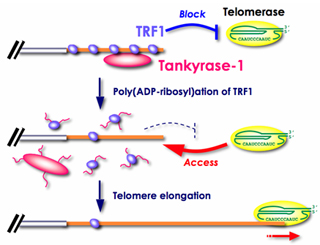
Tankyrase, a telomeric poly(ADP-ribose) polymerase (PARP), "acts as a positive regulator of telomere enlongation in vivo, apparently by inhibiting TRF1 [Index]. In general, PARP catalyzes the formation of poly(ADP-ribose) onto a protein acceptor using NAD+ as a substrate in response to DNA damage.
Long-term overexpression of tankyrase 1 in telomerase-positive human cells results in a gradual and progressive enlongation of telomeres. See "Overexpression of tankyrase 1 in telomerase-positive cells releases TRF1 from telomeres, resulting in telomere elongation." [2004], and H. Seimiya (2006),
The telomeric PARP, tankyrases, as targets for cancer therapy, British Journal of Cancer, 2006, 94, 341-345 [Figure 2].
Tankyrase 1 uses NAD as a stubstrate in poly(ADP-ribosylation) of TRF1, so NAD supplements [Images] may be useful when applying Tankyrase 1 to encourage hTERT transcription to activate telomerase.
Furthermore, nicotinamide
(niacinamide),
a form of Vitamin B3,
has been shown to boost
poly(ADP-ribose) polymerase
levels (Tammy M. Jackson, et. al., 1995).
Nicotinamide was used
to elevate PARP levels in experimental animals at 1 gram/kg dosage,
and was useful for upregulating NAD+ in the heart
at 500 mg/kg. "Phosphorylation
of tankyrase 1
results in upregulation of its intrinsic PARP activity."
(H. Seimiya,
2006). Phosphorylation is accomplished by insulin stimulation.
Tankyrase 1
is serine-phosphorylated by MAP kinases,
enhancing its telomeric PARP activity.
(Sbodio,
Lodish, and Chi, 2002).
"...Tankyrase is quantitatively phosphorylated on
certain serine residues
by MAP kinase upon stimulation with
insulin,
PDGF, and EGF."
(Chi
and Lodish, 2000).
Tankyrase 1 has more than 1 function in the cell. "Tankyrase 1 is a novel signaling target of mitogen-activated protein kinase (MAPK); it is stoichiometrically phosphorylated upon insulin stimulation. Phosphorylation enhances the poly(ADP-ribose) polymerase activity of tankyrase 1..." (Nai-Wen Chi and Harvey F. Lodish, 2000).
Phosphorylation allows tankyrase 1 to transduce MAPK signaling into poly(ADP-ribosyl)ation of effector proteins such as TRF1.
See upregulating tankyrase 1 mRNA transcription [Papers]. "TRF1 is a specific negative regulator of telomere length and its poly(ADP-ribosylation) by tankyrase 1 leads to the loss of telomere association and subsequent degradation by the ubiquitin/proteasome pathway (Chang et al. 2003, Smith et al. 1998)." (W.N.Keith and A.E.Bilsland, Targeting Telomerase: Therapeutic Options for Cancer Treatment, in K. Lenhard Rudolph, 2008, p.269.)
Perhaps adding an extra gene for tankyrase 1 with Zinc Finger Nuclease technology would be life-extending, if it did not much encourage carcinogenesis. Alternatively, tankyrase 1 plasmid expression vectors may be useful. See promoting tankyrase transcription. Evidently, going for a strong insulin spike after a bodybuilding workout (by using a specially formulated post-workout shake) can phosphorylate tankyrase, improving its performance as a telomerase activator. Furthermore, insulin itself may have this effect.
Gymnema Sylvestre (400-500 mg with a postworkout shake < 30 min after exercise) stimulates insulin secretion. Dextrose may be taken at 25-50 grams to spike insulin, along with whey protein or whey hydrolysates after a bodybuilding workout. Insulin secretion may also be improved by Fenugreek seeds, Fenugreek Extract [Images], or 4-hydroxyisoleucine [Images]. Tankyrase action on TRF1 can probably be promoted using Gymnema Sylvestre [Images] to produce insulin, phosphorylating Tankyrase 1 to increase its telomerase activation activity.
I note that a "tanky" race of men keeps its insulin high.
See TwinLabs
Creatine Nitrate3 Fuel.
See also Antisense
inhibition of Bcr-Abl/c-Abl synthesis promotes telomerase activity
and upregulates tankyrase in human leukemia cells,
FEBS letters,
2004, vol. 564, no1-2, pp. 73-84 [12 page(s) (article)].
Tankyrase 1 has a short reported half-life of just 2 hours.
Tankyrase 1 is overexpressed in human breast cancer,
so that novel
tankyrase inhibitors
(MST-312,
MST-295, and
MST-199) have been developed to function as
telomerase inhibitors for
application to anticancer therapy.
Furthermore, overexpression of
tankyrase 2, a related protein, results
in cell death (references from
H.
Seimiya, 2006). I add that there are also tankyrase-related proteins incorporating certain domains
of tankyrase 1 that perform like tankyrase 1 for purposes of opening telomere loops. There are also
nucleic acids (recombinant DNA molecules) that can bind to the acidic domain of a
TRF1. See De Lange, et al.,
TRF1 Binding Protein, Methods of Use Thereof,
US Patent
No. 6,277,613 B1, Aug. 21, 2001.
It seems clear that extra tankyrase 1 might be expressed by
supplying a DNA plasmid for transfection into the cell that is designed to encode tankyrase 1. Plasmids
with inducible promoters may be used, or perhaps
Plasmids of suitable half-life may be designed.
See Anderson, et al.,
US Patent 5,399,345.
Other compounds besides niacinamide might be used to improve NAD substrate levels for tankyrase 1 reactions with TRF1, and targeted phosphorylation of tankyrase 1 using substances besides insulin may be envisioned, perhaps vanadyl sulphate.
Also note that the effect of tankyrase 1 is different
on long telomeres (> 20 kbp) than on short telomeres,
where it acts to remove TRF1 for telomerase access (De Lange, et al, 2001). This because long telomeres
seem to support a coiled higher-order structure in the presence of sufficient TRF1. See
Smith, S., I. Giriat, A. Schmitt, and T. de Lange. (1998),
Tankyrase,
a poly(ADP-ribose) polymerase at human telomeres,
Science 282:1484-1487.
See also Cook, B. D., J. N. Dynek, W. Chang, G. Shostak, and S. Smith (2002), Role for the related poly(ADP-Ribose) polymerases tankyrase 1 and 2 at human telomeres, Mol. Cell. Biol, 22:332-342. Also of revelance is Ye J.Z., and de Lange, T. (2004), TIN2 is a tankyrase 1 PARP modulator in the TRF1 telomere length control complex, Nature Genetics, 36, 618-623. See also Nai-Wen Chi and Harvey F. Lodish (2000), Tankyrase Is a Golgi-associated Mitogen-activated Protein Kinase Substrate That Interacts with IRAP in GLUT4 Vesicles, Journal of Biological Chemistry, December 8, 2000, 275, 38437-38444. This is a reference for the phosphorylation of tankyrase 1 resulting in the upregulation of its activity. "In insulin-stimulated adipocytes, tankyrase 1 is phosphorylated at serine residues by the mitogen-activated protein kinase pathway." - After H. Seimiya, op.cit., referencing (Chi and Lodish, 2000), op.cit. Note that "...Tankyrase is quantitatively phosphorylated on certain serine residues by MAPK upon stimulation with insulin, PDGF, and EGF." (Chi and Lodish, 2000).
The phosphorylation of tankyrase 1 enhances its poly(ADP-ribo)sylation activity on TRF1 telomere loop closure protein, allowing t-loops to open for access by the telomerase holoenzyme. For application of tankyrase wisdom to cancer, see Hiroyuki Seimiya, Yukiko Muramatsu, Tomokazu Ohishi, and Takashi Tsuruo (2005), Tankyrase 1 as a target for telomere-directed molecular cancer therapeutics, Cancer Cell, Vol.7, issue 1, January 2005, pp.25-37. Also see Susan Smith and Titia de Lange (2000), Tankyrase promotes telomere enlongation in human cells, Current Biology, vol 10, no. 20, 1299-1302 with Susan Smith and Titia de Lange, TRF1 Binding Protein, Methods of Use Thereof, US Patent 6,277,613 B1. "Tankyrase does not contain a nuclear localization signal (NLS) and transfected tankyrase is excluded from the nucleus unless it is co-transfected with TRF1.... (An NLS can be added to its amino terminus to produce nuclear-localized tankyrase (FN-tankyrase))... Tankyrase releases TRF1 from telomeres in a reaction that depends on its PARP domain".
Doxycyclin
Presence or absence of telomere growth can depend on the presence of doxycyclin
[Links/doxycyclin,
Images,
Papers,
Patents,
Books;
Links/doxycyclin and telomere growth,
Images,
Papers,
Patents,
Books].
Tankyrase, a telomeric poly(ADP-ribose) polymerase (PARP), "acts as a positive regulator of telomere enlongation in vivo, apparently by inhibiting TRF1 [Index]. In general, PARP catalyzes the formation of poly(ADP-ribose) onto a protein acceptor using NAD+ as a substrate in response to DNA damage.
Long-term overexpression of tankyrase 1 in telomerase-positive human cells results in a gradual and progressive enlongation of telomeres. See "Overexpression of tankyrase 1 in telomerase-positive cells releases TRF1 from telomeres, resulting in telomere elongation." [2004], and H. Seimiya (2006),
The telomeric PARP, tankyrases, as targets for cancer therapy, British Journal of Cancer, 2006, 94, 341-345 [Figure 2].
Tankyrase 1 uses NAD as a stubstrate in poly(ADP-ribosylation) of TRF1, so NAD supplements [Images] may be useful when applying Tankyrase 1 to encourage hTERT transcription to activate telomerase.
Tankyrase 1 has more than 1 function in the cell. "Tankyrase 1 is a novel signaling target of mitogen-activated protein kinase (MAPK); it is stoichiometrically phosphorylated upon insulin stimulation. Phosphorylation enhances the poly(ADP-ribose) polymerase activity of tankyrase 1..." (Nai-Wen Chi and Harvey F. Lodish, 2000).
Phosphorylation allows tankyrase 1 to transduce MAPK signaling into poly(ADP-ribosyl)ation of effector proteins such as TRF1.
See upregulating tankyrase 1 mRNA transcription [Papers]. "TRF1 is a specific negative regulator of telomere length and its poly(ADP-ribosylation) by tankyrase 1 leads to the loss of telomere association and subsequent degradation by the ubiquitin/proteasome pathway (Chang et al. 2003, Smith et al. 1998)." (W.N.Keith and A.E.Bilsland, Targeting Telomerase: Therapeutic Options for Cancer Treatment, in K. Lenhard Rudolph, 2008, p.269.)
Perhaps adding an extra gene for tankyrase 1 with Zinc Finger Nuclease technology would be life-extending, if it did not much encourage carcinogenesis. Alternatively, tankyrase 1 plasmid expression vectors may be useful. See promoting tankyrase transcription. Evidently, going for a strong insulin spike after a bodybuilding workout (by using a specially formulated post-workout shake) can phosphorylate tankyrase, improving its performance as a telomerase activator. Furthermore, insulin itself may have this effect.
Gymnema Sylvestre (400-500 mg with a postworkout shake < 30 min after exercise) stimulates insulin secretion. Dextrose may be taken at 25-50 grams to spike insulin, along with whey protein or whey hydrolysates after a bodybuilding workout. Insulin secretion may also be improved by Fenugreek seeds, Fenugreek Extract [Images], or 4-hydroxyisoleucine [Images]. Tankyrase action on TRF1 can probably be promoted using Gymnema Sylvestre [Images] to produce insulin, phosphorylating Tankyrase 1 to increase its telomerase activation activity.
Other compounds besides niacinamide might be used to improve NAD substrate levels for tankyrase 1 reactions with TRF1, and targeted phosphorylation of tankyrase 1 using substances besides insulin may be envisioned, perhaps vanadyl sulphate.
See also Cook, B. D., J. N. Dynek, W. Chang, G. Shostak, and S. Smith (2002), Role for the related poly(ADP-Ribose) polymerases tankyrase 1 and 2 at human telomeres, Mol. Cell. Biol, 22:332-342. Also of revelance is Ye J.Z., and de Lange, T. (2004), TIN2 is a tankyrase 1 PARP modulator in the TRF1 telomere length control complex, Nature Genetics, 36, 618-623. See also Nai-Wen Chi and Harvey F. Lodish (2000), Tankyrase Is a Golgi-associated Mitogen-activated Protein Kinase Substrate That Interacts with IRAP in GLUT4 Vesicles, Journal of Biological Chemistry, December 8, 2000, 275, 38437-38444. This is a reference for the phosphorylation of tankyrase 1 resulting in the upregulation of its activity. "In insulin-stimulated adipocytes, tankyrase 1 is phosphorylated at serine residues by the mitogen-activated protein kinase pathway." - After H. Seimiya, op.cit., referencing (Chi and Lodish, 2000), op.cit. Note that "...Tankyrase is quantitatively phosphorylated on certain serine residues by MAPK upon stimulation with insulin, PDGF, and EGF." (Chi and Lodish, 2000).
The phosphorylation of tankyrase 1 enhances its poly(ADP-ribo)sylation activity on TRF1 telomere loop closure protein, allowing t-loops to open for access by the telomerase holoenzyme. For application of tankyrase wisdom to cancer, see Hiroyuki Seimiya, Yukiko Muramatsu, Tomokazu Ohishi, and Takashi Tsuruo (2005), Tankyrase 1 as a target for telomere-directed molecular cancer therapeutics, Cancer Cell, Vol.7, issue 1, January 2005, pp.25-37. Also see Susan Smith and Titia de Lange (2000), Tankyrase promotes telomere enlongation in human cells, Current Biology, vol 10, no. 20, 1299-1302 with Susan Smith and Titia de Lange, TRF1 Binding Protein, Methods of Use Thereof, US Patent 6,277,613 B1. "Tankyrase does not contain a nuclear localization signal (NLS) and transfected tankyrase is excluded from the nucleus unless it is co-transfected with TRF1.... (An NLS can be added to its amino terminus to produce nuclear-localized tankyrase (FN-tankyrase))... Tankyrase releases TRF1 from telomeres in a reaction that depends on its PARP domain".
Doxycyclin
Subscribe to:
Posts (Atom)